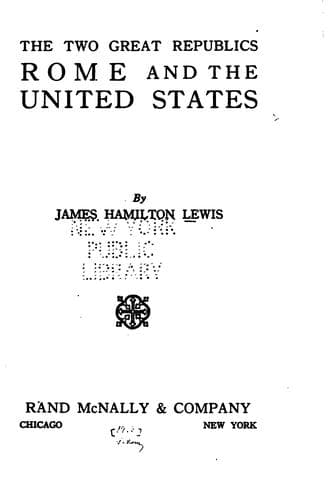
The Two Great Republics: Rome and the United StatesLewis, James
History
The Two Great Republics: Rome and the United States
Lewis, James
Rome -- Politics and government -- 510-30 B.C.; United States -- Politics and government
whence did that insatiable desire of power and rule proceed,
but from a superabundance of riches? This it was that armed
Cæsar and Pompey with fatal weapons for the destruction of
the state.
"Almost the whole world being now subdued, the Roman Empire
was grown too great to be overthrown by any foreign power.
Fortune, in consequence, envying the sovereign people of the
earth, armed it to its own destruction. The outrages of
Marius and Cinna had already made a sort of prelude within
the city. The storm of Sulla had thundered even farther, but
still within the bounds of Italy. The fury of Cæsar and
Pompey, as with a general deluge or conflagration, overran
the city, Italy, other countries and nations, and finally
the whole empire wherever it extended; so that it cannot
properly be called a civil war, or war with allies; neither
can it be termed a foreign war; but it was rather a war
consisting of all these, or even something more than a war.
If we look at the leaders in it, the whole of the senators
were on one side or the other; if we consider the armies,
there were on one side eleven legions, and on the other
eighteen; the entire flower and strength of the manhood of
Italy. If we contemplate the auxiliary forces of the allies,
there were on one side levies of Gauls and Germans, on the
other Deiotarus, Ariobarzanes, Tarcondimotus, Cotys, and all
the force of Thrace, Cappadocia, Cilicia, Macedonia, Greece,
Ætolia, and all the East; if we regard the duration of the
war, it was four years, a time short in proportion to the
havoc made in it; if we attend to the space and ground on
which it was conducted, it arose within Italy, whence it
spread into Gaul and Spain, and returning from the West,
settled with its whole force on Epirus and Thessaly; hence
it suddenly passed into Egypt, then turned towards Asia,
next fell upon Africa, and at last wheeled back into Spain,
where it at length found its termination. But the
animosities of parties did not end with the war, nor
subsided till the hatred of those who had been defeated
satiated itself with the murder of the conqueror in the
midst of the city and the senate.
Public-domain text, read in full here on John Shaqi.
Reviews
Reviews
No reviews yet
Be the first to share your thoughts on this work.
Elsewhere in the archive
Join the Discussion
Join the discussion
Sign in to leave a comment or review.
Sign InorCreate an account