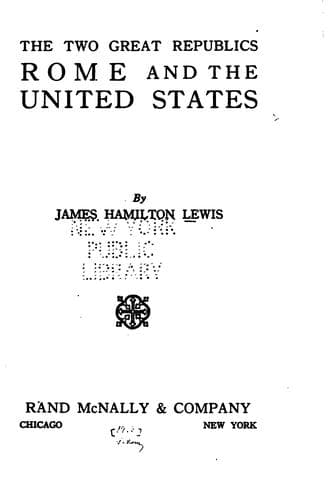
The Two Great Republics: Rome and the United StatesLewis, James
History
The Two Great Republics: Rome and the United States
Lewis, James
Rome -- Politics and government -- 510-30 B.C.; United States -- Politics and government
"At the same time that Cæsar went to the palace in his
litter, one of his domestics, who had understood something
of the conspiracy, came to find Calpurnia; but without
saying anything to her but that he must speak with Cæsar
about affairs of importance, he stayed, expecting his return
from the Senate, because he did not know all the
particulars; his host of Cnidus, called Artemidorus, running
to the palace to give him notice of it, came just at the
moment of his being killed; another, as he sacrificed before
the gate of the senate house, gave him a note of all the
conspiracy; but he going in without reading it, it was after
death found in his hands. As he came out of his litter,
Lænas, the same who before had spoken to Cassius, came to
him, and entertained him a long time in private; which
struck a damp into the chiefs of the conspiracy, the more
because their conference was long; they already began to
make signs to one another that they must now kill him before
he arrested them; but in the sequel of the discourse,
observing Lænas to use rather the gesture of suppliant than
accuser, they deferred it; till in the end, seeing him
return thanks to Cæsar, they took courage.
"They left Trebonius at the gate to stop Antony under the
pretense of discoursing some business with him; and as soon
as Cæsar was seated, the other conspirators surrounded him
according to custom, as friends, having each his dagger
concealed. At the same time Attilius Cimber standing before
him began to entreat him to grant the return of his brother
who was an exile; and upon his refusal, under pretence of
begging it with more humility, he took him by the robe, and,
drawing it to him, hung about his neck, crying out, 'Why do
you delay, my friends?' Thereupon Casca first of all
reaching over his head, thought to strike his dagger into
his throat, but wounded him only in the breast. Cæsar,
having disengaged himself from Cimber, caught hold of
Casca's hand, leaped from his seat, and threw himself upon
Casca with a wonderful force; but being at handy grips with
him, another struck his dagger into his side, Cassius gave
him a wound in the face, Brutus struck him quite through the
thigh, Bucolianus wounded him behind the head, and he, like
one enraged, and roaring like a savage beast, turned
sometimes to one and sometimes to another; till strength
failing him after the wound received from Brutus, he threw
the skirt of his robe over his face and suffered himself
gently to fall before Pompey's statue. They forebore not to
give him many stabs after he was down; so that there were
three and twenty wounds found in his body. And those that
slew him were so eager that some of them, through vehemence,
without thinking of it, wounded each other."
Public-domain text, read in full here on John Shaqi.
Reviews
Reviews
No reviews yet
Be the first to share your thoughts on this work.
Elsewhere in the archive
Join the Discussion
Join the discussion
Sign in to leave a comment or review.
Sign InorCreate an account