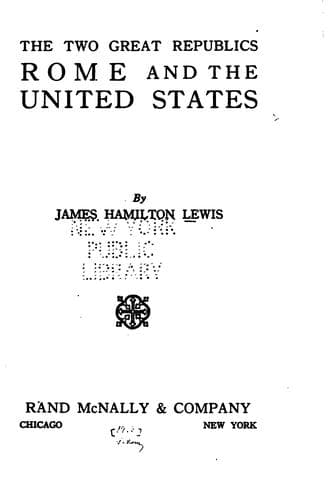
The Two Great Republics: Rome and the United StatesLewis, James
History
The Two Great Republics: Rome and the United States
Lewis, James
Rome -- Politics and government -- 510-30 B.C.; United States -- Politics and government
"A rumor was spread that there was an oracle of the Sibyls
which declared that the Parthians could not be subdued by
the Romans, unless they were commanded by a king. This made
some talk publicly that in regard of other nations taxed
under the Roman empire, there needed no scruple be made at
the giving Cæsar that title. He, having still refused it,
hastened all he could to get out of the city where many
envied him. But four days before the day appointed for his
departure he was slain by his enemies in the palace, either
out of malice to see him raised to such supreme felicity and
height of command, or else (as themselves said) out of a
desire to restore the commonwealth to its first estate; for
they feared that, after having overcome these other nations,
nothing could hinder him from making himself king; yet as it
appears to me it was only for the name's sake they
attempted all things; for in the thing itself there is no
difference between dictator and king.
"There were two chiefs of this conspiracy, the son of that
Brutus whom Sulla put to death, M. Brutus Cæpio, who came
for refuge to Cæsar himself after the battle of Pharsalus,
and C. Cassius, who yielded to him the galleys in the
Hellespont, both of Pompey's party, and with them was joined
one of Cæsar's most intimate friends, Decimus Brutus
Albinus.
"Having all decreed the palace the place of execution, there
were divers opinions concerning the manner of doing it; some
being of opinion that they should likewise make away with
Antony, Cæsar's colleague, the most powerful of his friends,
and well beloved of the soldiery. But Brutus opposed that,
saying that it was only by killing Cæsar, who was as a king,
that they ought to seek for the glory of destroying tyrants;
and that if they killed his friends too, men would impute
the action to private enmity, and the faction of Pompey.
This advice prevailing, they only expected the assembling of
the Senate. Now the day before, Cæsar being invited to sup
with Lepidus, carried along with him Decimus Brutus Albinus;
and during supper the question being proposed what death was
best for man, some desiring one kind, and some another, he
alone preferred the suddenest and most unexpected. Thus
divining for himself, they fell to discourse of the morrow's
affairs.
Public-domain text, read in full here on John Shaqi.
Reviews
Reviews
No reviews yet
Be the first to share your thoughts on this work.
Elsewhere in the archive
Join the Discussion
Join the discussion
Sign in to leave a comment or review.
Sign InorCreate an account