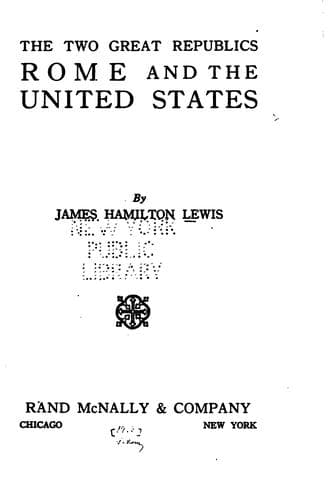
The Two Great Republics: Rome and the United StatesLewis, James
History
The Two Great Republics: Rome and the United States
Lewis, James
Rome -- Politics and government -- 510-30 B.C.; United States -- Politics and government
"It is true that the cautious reformer adopted into his new
system of government the old names and the offices which had
come down from republican times, with the exception of the
censorship and the dictatorship, which last had long been
obsolete. But these were intended from the outset to lead
but a phantom existence and to take no part in the great
task of imperial administration. Augustus drew his own body
of officials from the knightly class, and under the
unpretentious titles of procurator and præfect practically
committed the whole administration of the empire to their
hands, reserving, apart from certain distinguished sinecures
in Rome, and Italy, for the senators the præfecture of the
city, all the great governorships except Egypt, and the
highest commands in the army. The handsome salaries--varying
in the later days of the empire from £600 to £3,600 ($3,000
to $18,000)--and the great influence attached to the
procuratorial career, which opened the way to the lofty
positions of præfect of Egypt and commander of the prætorian
guards at Rome, rendered the service very desirable and
highly esteemed.
"While the high-born magistrates of the republic entered
upon their one year's tenure of office without any training
whatsoever, and were, of course, obliged to rely upon the
knowledge and trustworthiness of the permanent staff of
clerks, recorders and cashiers in their department, there
grew up under the empire a professional class of government
officials who, schooled by years of experience and
continuance in office and supported by a numerous staff
recruited from the imperial freedmen and slaves, were in a
position to cope with the requirements of a world-wide
empire. These procurators, some as governors-in-chief of the
smaller imperial provinces, some as assistants to the
governors of the greater, watched over the interests of the
public exchequer and the emperor's private property, or
looked after the imperial buildings and aqueducts, the
imperial games, the mint, the corn supply of Rome, and the
alimentary institutions, the legacies left to the emperors,
their castles and demesnes in Italy and abroad,--in short,
everything that fell within the vast and ever widening
sphere of imperial government. Meanwhile the exchequer of
the senate dwindled and dwindled, till it finally came to be
merely the exchequer of the city of Rome."
Public-domain text, read in full here on John Shaqi.
Reviews
Reviews
No reviews yet
Be the first to share your thoughts on this work.
Elsewhere in the archive
Join the Discussion
Join the discussion
Sign in to leave a comment or review.
Sign InorCreate an account