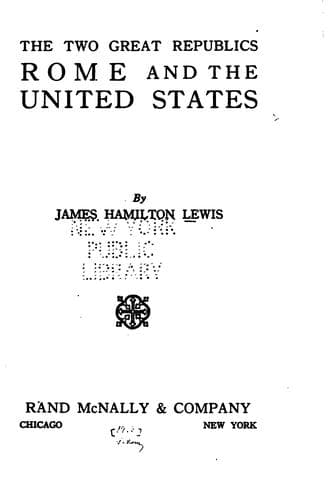
The Two Great Republics: Rome and the United StatesLewis, James
History
The Two Great Republics: Rome and the United States
Lewis, James
Rome -- Politics and government -- 510-30 B.C.; United States -- Politics and government
There is scarcely any event which takes place upon this earth which
produces unmixed evil or unmixed good. There is some slight element of
truth in some of the statements of the last quotation. There was some
temporary restraint placed upon the dishonesty and cruelty of the
Roman tax collectors; and there was undoubtedly a permanent
improvement in the ability of the men holding the minor positions
under the Roman government, through the introduction of what may be
called a civil-service system. But the contention that the
establishment of the empire was for the benefit either of the Roman
citizens or of the Roman subjects is too ridiculous to merit even a
denial. To show the ridiculousness of such a statement it is only
necessary to point to the history of the Roman empire during the half
century following the death of Octavius Cæsar. Corrupt as the
administration of the government often was under the republic, and
cruel as were the successful factional leaders on a few occasions,
such conditions as existed in Rome under the emperors Tiberius,
Caligula, and Nero could never have existed under the republic.
The character of the Roman empire was a most anomalous one. In the
history of the empire we find the unparalleled situation of an
absolute despotism without any hereditary nobility and even without
any well-established principle as to the descent of the royal power to
the children of the deceased emperor. Under the most despotic days of
the empire any Roman citizen might rise to any position of power or
dignity under the emperor; nay, more than this, any subject of the
Roman empire, no matter how low his origin or condition in society,
might be thrust, by a lucky turn of the wheel of fortune, into the
imperial purple itself.
The Roman emperors came from every strata of society, and from every
portion of the Roman empire. At different times we see the son of a
slave, a Syrian sun priest, a Dacian peasant, seated in the chair of
the Cæsars; but this state of affairs in no way alleviated or excused
the evils which the empire brought upon its subjects. The exploitation
of the millions at the hands of a favored few is not rendered more
defensible by the fact that any individual has the chance, by
extraordinary ability, extraordinary dishonesty, or extraordinary good
fortune, to raise himself out of the ranks of the exploited into those
of the exploiters.
Public-domain text, read in full here on John Shaqi.
Reviews
Reviews
No reviews yet
Be the first to share your thoughts on this work.
Elsewhere in the archive
Join the Discussion
Join the discussion
Sign in to leave a comment or review.
Sign InorCreate an account