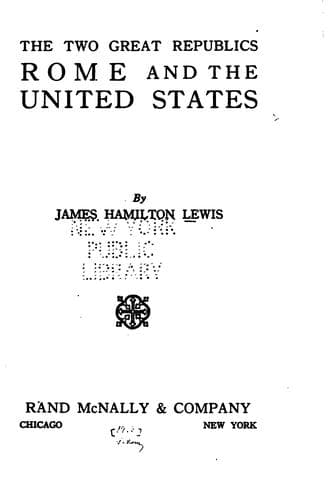
The Two Great Republics: Rome and the United StatesLewis, James
History
The Two Great Republics: Rome and the United States
Lewis, James
Rome -- Politics and government -- 510-30 B.C.; United States -- Politics and government
The story of the Gracchi is replete with suggestions of comparisons
with modern conditions. The failure of these reformers was primarily
due to the lack of steadfast perseverance on the part of the mass of
their followers. It is this same phenomenon which does more than any
other to bring about the failure of needed and widely supported
reforms at the present time in our country. It is always much easier
to win the support of a majority of voters to a reform measure than it
is to retain such majority during the tedious delays which the
opponents of reform are so adept in producing. Delay is always the
great weapon of the supporters of any special interest which is
attacked. The beneficiaries from unfair discriminations or special
interests, and their allies, never desert the fight from weariness, no
matter how long it may be continued; but once the first spell of
enthusiasm has passed away, the supporters of the reform gradually
drop by the wayside. How many times have we seen the people vote time
after time in support of a certain reform only to weaken at the
crisis, and allow the ultimate victory to rest with the supporters of
special interests! For illustration we need only cite the long contest
in the metropolis of the West for a fair deal to the people from the
street-car companies, where after nine years of contest the majority
of the voters, at the critical contest, deserted the mayor, who had
resolutely stood for the principles for which the voters had declared
year after year, and gave to the companies a contract giving them all
that they had even dared to hope for.
The deposition of the tribune Marcus Octavius is without question the
first historical application of the principle of the recall of public
officials. This precedent was never again followed at Rome, and the
recall of public officers never became a part of the Roman political
system. Such an expedient, in fact, could never have been necessary at
Rome, except in very extreme cases, on account of the very short terms
of office for which all Roman officials were elected. The only states
of this country which follow the Roman example in this respect are
some of the New England states.
The actions of the Roman proletariat in so consistently supporting the
grain laws of Gaius Gracchus, and in so soon disregarding his
proposals for the allotment of the public land, are very typical of
the attitude of a vast element in every community. The too great
concern for the present and the too great disregard for the future are
among the greatest obstacles to be overcome by those who attempt to
line up the people of any community in the support of true
constructive reforms.
Side by side with the lack of true proportion in the view taken by the
majority of men, of the relative importance of different measures,
stand the constant errors made by the people in their judgment of the
character and objects of different politicians.
Public-domain text, read in full here on John Shaqi.
Reviews
Reviews
No reviews yet
Be the first to share your thoughts on this work.
Elsewhere in the archive
Join the Discussion
Join the discussion
Sign in to leave a comment or review.
Sign InorCreate an account