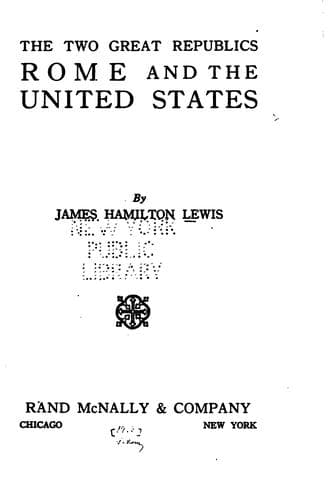
The Two Great Republics: Rome and the United StatesLewis, James
History
The Two Great Republics: Rome and the United States
Lewis, James
Rome -- Politics and government -- 510-30 B.C.; United States -- Politics and government
The veto power of the Roman tribune was an innovation in government.
It was, however, a political idea which was destined to take deep
root, and to be copied by countries whose very beginnings were, as
yet, far in the future. There is to-day no constitutional government
in whose organization the veto power is not found in some form; in the
great majority of modern governments the veto power occupies a most
prominent place.
The modern veto power has departed far from that of the Roman tribune,
both in practice and theory. The veto power of the latter was merely a
check upon power; the modern veto power is both a check upon power and
a positive power in the hands of the official to whom it is given.
The Roman veto was given to an officer who had no power except of a
negative character; it could be interposed against executive acts and
judicial proceedings as well as against legislative enactments.
The modern veto power is directed solely against legislative acts and
is put in the hands of the executive department of the government.
Against the legislative department it is a check, but to the executive
department it is a grant of positive power. In the United States the
veto is more a club in the hands of the executive department than a
check upon the legislative. The veto power also tends to break down
the dividing line between the executive and the legislative
departments. In the United States the President and the governors of
the different states in reality constitute a third branch of the
respective legislative departments.
Public-domain text, read in full here on John Shaqi.
Reviews
Reviews
No reviews yet
Be the first to share your thoughts on this work.
Elsewhere in the archive
Join the Discussion
Join the discussion
Sign in to leave a comment or review.
Sign InorCreate an account