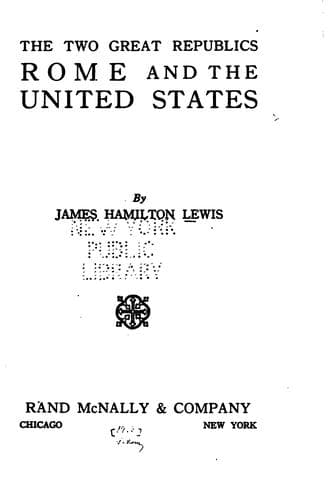
The Two Great Republics: Rome and the United StatesLewis, James
History
The Two Great Republics: Rome and the United States
Lewis, James
Rome -- Politics and government -- 510-30 B.C.; United States -- Politics and government
It is not only in great but also in smaller things that we see the
ever-recurring resemblances between Roman and American conditions.
Cicero's complaint, "Let me tell you that there is no class of people
so harassed by every kind of unreasonable difficulty as candidates for
office," finds a responsive chord in every modern American politician.
His account of his campaign for the consulship at Rome, as well as the
historical record of other Roman political contests, shows many points
of similarity between the details of the problems and methods of
ancient and modern political battles.
Political expenditures, in the latter days of the Roman republic, had
become an even greater evil than is the case in the United States
to-day. It is interesting, though alarming, to note that the greater
political freedom became at Rome, the greater became the amount of
political expenditures and the greater the power of money in
elections. A similar alarming phenomenon has recently been noticed in
this country in the greater increase of political expenditures which
have followed the introduction of the direct primaries, and the
consequent greater difficulties of the candidate for office not
possessed of a large fortune.
Innumerable other points of resemblance might be mentioned to complete
the comparison between Roman and American political conditions. A
strong point in the Roman character (at least during the greater part
of the republican period) is found in the fact that foreign
hostilities always produced a cessation, or at least a laxation, of
domestic political hostilities. This was in striking contrast with the
general rule in Grecian cities, where one political faction or another
would generally seize the opportunity offered by the external
difficulties of their state to advance their selfish individual
interests at the expense of the public. The public attitude in America
has always resembled the Roman rather than the Grecian attitude.
Perhaps this attitude in America has sometimes been carried too far,
and resulted in too great a degree of credit and support being given
to the party in power, for victories won by the united efforts of
members of all political parties in the country.
The effect of a mere name, both in Rome and in the United States, has
always been unduly great. The charge (even when entirely unsupported)
that a Roman politician was aiming to make himself a king was
generally sufficient to drive him from power; though the Romans
finally calmly submitted to the rule of an absolute ruler under the
new title of emperor. The efficiency of denunciation by calling names,
instead of by argument, is known and made use of in American politics.
Public-domain text, read in full here on John Shaqi.
Reviews
Reviews
No reviews yet
Be the first to share your thoughts on this work.
Elsewhere in the archive
Join the Discussion
Join the discussion
Sign in to leave a comment or review.
Sign InorCreate an account