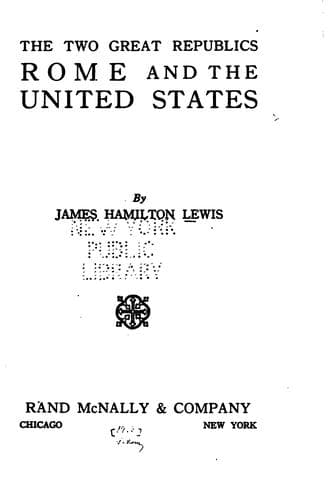
The Two Great Republics: Rome and the United StatesLewis, James
History
The Two Great Republics: Rome and the United States
Lewis, James
Rome -- Politics and government -- 510-30 B.C.; United States -- Politics and government
The pretense of patriotism in America assumed by having one's self
designated by a name of patriotic appellation--such as "Honest" John
Doe, "Brave" Richard Roe, and the "Patriot" John Stiles--is but a
parallel to the schemes of the ancient tricksters. Truly, there is
nothing new under the sun, and as man so are republics of men--both
alike in greatness and in littleness.
There is slight opportunity for comparison between the Roman colonial
system and that of our own country. It is true that of both alike it
may be said the beginning of foreign conquest came as an accident, and
the acquisition of territory beyond the seas found them unprepared
for its government. Here, it is to be hoped, the resemblance will be
found to have ceased. When Rome had once tasted the fruits of foreign
conquest, the extension of such conquests became the great object of
Roman ambition. It was not by accident but by deliberately planned
wars of conquest that the so-called world empire of the Romans was
acquired.
With the United States the comparatively few and unimportant insular
possessions are still a matter of secondary concern. But few of the
citizens of this country give any thought or attention to these
possessions, and many even favor their abandonment.
Both Rome and the United States found the problem of reconciling
foreign colonies with republican institutions a difficult one. The
Roman administration of her colonies was always tinged with corruption
and injustice; and, unfortunately, our own insular rule has not been
entirely free from these evils. A great trouble in the case of each
republic was that she failed or refused to make any real effort to
introduce her own principles of government into the government of her
provinces. There is much more excuse for this failure in the case of
Rome than in that of our own country. As was shown in the chapter on
Roman legislative assemblies, her ignorance of the principle of
representative legislative assemblies made the extension of free
government over extended areas impossible, or at least very difficult.
But our own system of local self-government is one adapted to any
country, and capable of indefinite expansion. The highly centered
bureaucracy of the Philippine government is one without precedent in
our own country, and without any fitness for the Philippines or any
other colony. The slight self-government given to the Filipinos is
merely enough to call attention to that which is refused them. No
successful government of these Islands, either by our country or by
the Filipinos themselves, will ever be secured while all questions of
government for so many diverse races are settled by a few high
government officials at the capital--Manila. Particularly will this
objectionable condition continue so long as the places of authority
are filled by men named from every portion of the country except that
part most nearly associated with the destiny of the Islands. The
Public-domain text, read in full here on John Shaqi.
Reviews
Reviews
No reviews yet
Be the first to share your thoughts on this work.
Elsewhere in the archive
Join the Discussion
Join the discussion
Sign in to leave a comment or review.
Sign InorCreate an account