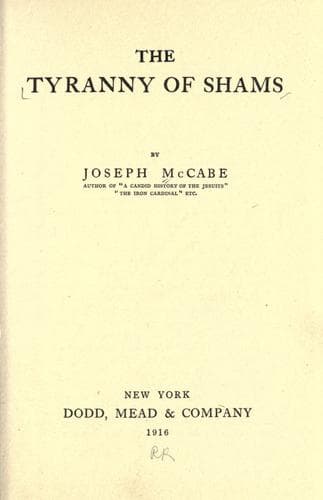
Great Britain -- Social conditions; Moral conditions; Social problems
Why did the State, in the first half of the nineteenth century,
undertake the task of educating the young? I do not mean that
State-education was a new thing in history when a few European
Governments adopted it little over a century ago. The Roman Empire had
had a very fair system of municipal and State-education, and it is one
of the gravest charges against the clergy that they suffered it to
decay, and allowed or compelled ninety per cent. of their followers to
remain in a state of gross ignorance for fourteen hundred years. At
the end of the eighteenth century, as the revolt against
ecclesiastical authority spread, the idea of State-education was
revived. In England the clergy warmly resisted the progress of the
idea, but the appalling ignorance of the people proved intolerable to
the increasing band of reformers. Quakers like Lancaster and Agnostics
like Robert Owen demanded and provided schools for the children of the
workers, and the Church of England was forced to meet this danger of
unsectarian education by founding a rival and orthodox association.
But for fifty years the schooling remained so primitive, and the
proportion of illiterates remained so enormous, that at last the
bishops were brushed aside and the Government was compelled to resume
the work of the old Roman municipalities and Senate.
The motives of the reformers and statesmen who secured this advance
were complex. Some of them were frankly anti-clerical and eager to
undermine superstition: some of them were business-men who pleaded
that a lettered worker was worth more to the State than an illiterate
worker. The predominant feeling was, as it had been among the Stoic
reformers at Rome, humanitarian. The gross ignorance of the mass of
the people was a disgrace to civilisation and a source of brutality
and crime: it was a human duty to educate. It was very widely
recognised that this sentiment imposed on us a duty of developing the
child's character as well as its mind, but here the Churches were
inflexible. Unblushingly asserting that they were the historic
educators of Europe, they refused to relinquish their last hold on the
school, and the State was compelled to accept the compromise of
religious instruction in the public schools, as well as the endowment
of sectarian schools. As to the third part of the ideal of education,
the cultivation of the body, we may admit that science itself was not
yet sufficiently advanced to demand it.
Public-domain text, read in full here on John Shaqi.
Reviews
Reviews
No reviews yet
Be the first to share your thoughts on this work.
Elsewhere in the archive
Join the Discussion
Join the discussion
Sign in to leave a comment or review.
Sign InorCreate an account