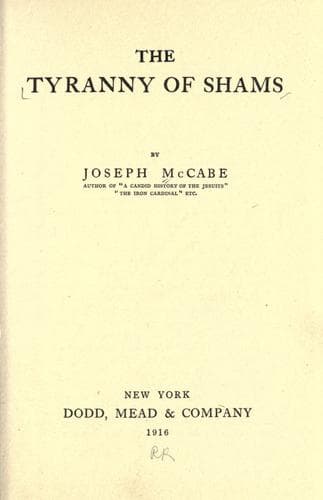
Great Britain -- Social conditions; Moral conditions; Social problems
If we speak of our actual world, not of an ideal world, this fact is
too patent to need proving. Forty-five years ago a band of enthusiasts
fought for the establishment of universal elementary education. The
survivors of that band confess that the splendid results they
anticipated have not been secured. One is, indeed, tempted sometimes
to wonder whether there was not more zeal for culture among the
workers half a century ago than there is to-day. When you listen to a
conversation, of workers or of average middle-class people, on
politics or theology or some other absorbing topic, you are astounded
at the slender amount of personal thinking and the slavery to phrases
which they have heard. Their minds seem to resemble the screen of a
kaleidoscope, on which the coloured phrases they have read in journals
or cheap literature weave automatic patterns. I speak, of course, of
the mass. I have given hundreds of scientific lectures to keen
audiences of working men, and I know that tens of thousands of them
have excellent collections of familiar books. But the result of
forty-five years of education is far from satisfactory. It was thought
that, when the people learned to read, and the ideas of an Emerson or
a Darwin could be appropriated by any man of moderate endowment, the
level of the race would rise materially. It has not risen as much as
was expected. The phrases are learned and repeated: the ideas are not
vitally assimilated, because the intellect is not sufficiently
developed.
Two classes of people will impatiently retort that there is no need
for further development. One class consists of those who dread a
higher intelligence in the workers because it leads to discontent with
their condition. To which one may reply that this concern comes too
late. One needs little intelligence to perceive the inequalities of
the distribution of wealth. The workers of the world have perceived
it, and, although only an extreme Socialist minority demands
equalisation, the mass of the workers demand a higher reward. Midway
between Australia and England, on the deck of a liner, I heard a group
of middle-class men and women contrasting the menace of the Australian
workers with the industrial content of the mother-country. We landed,
to find from the journals that the whole United Kingdom was punctuated
by strikes, agitations, and demands. It is too late. A distinguished
Belgian prelate was taken into a large foundry, and, observing the
workers, he impulsively cried: "What a slave's life!" "Hush,
they will hear you," said the manager. In repeating the experience
he added: "They have heard: it is too late." It will be better now
if, in the industrial struggle of the future, there is intelligence as
well as principle on both sides. If any large proportion of work in
the human economy requires the sacrifice of the intelligence, there is
something wrong with the work.
Public-domain text, read in full here on John Shaqi.
Reviews
Reviews
No reviews yet
Be the first to share your thoughts on this work.
Elsewhere in the archive
Join the Discussion
Join the discussion
Sign in to leave a comment or review.
Sign InorCreate an account