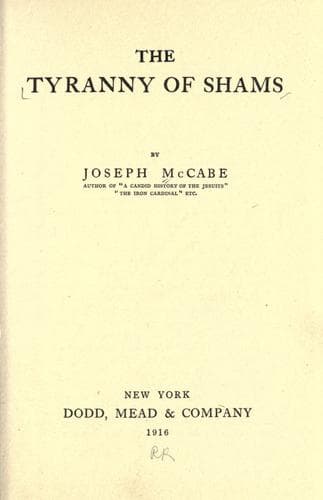
Great Britain -- Social conditions; Moral conditions; Social problems
It will be a part of this increased efficiency to rid our secondary
and higher schools of clerical domination. It is futile to say that
the clergyman must represent morals and religion in the school. His
record as a moralist during fifteen hundred years does not recommend
his services. Even to-day public schools which retain the tradition of
clerical masters are deplorable from the moral point of view. Some of
them are nurseries of a vice which, unless it be discontinued when the
youth goes out into the world, may bring on him one of the most
degrading sentences of our penal law. The clerical _method_ of
character-training--one admits, of course, great occasional
personalities--has little influence on these things. Public-school
boys, and especially young men at our universities, know that every
syllable which the preacher addresses to them is disputed, and no
other ground of right and healthy conduct is, as a rule, impressed on
them. Many will know that the grossest opinion of the clergy
themselves is current in our public schools and older universities,
and is embodied in numbers of scurrilous stories. The position of the
clergyman in our educational world is false. He is there for the same
reason that the Bible is in the elementary school: in the interest of
the Churches. We have improved mental education enormously since it
ceased to be a monopoly of the clergy. Possibly we will make a similar
improvement in character-training; we can hardly do it with less
success than they have done.
CHAPTER IX.
THE EDUCATION OF THE ADULT
IF it be granted that it is the interest and the duty of a nation to
develop the intelligence of its people, we must conclude that the work
is only half done, or not half done, by even an ideal system of what
is commonly called education. I am assuming that a time will come when
no youth or maiden will enter workshop or office before the age of
seventeen, if not eighteen; and that the better endowed minority of
our children will, without regard to their private resources, be
promoted to secondary, technical, and higher schools. This minority
will, on the whole, need no further attention. Cultural interest and
professional stimulation will ensure that their studies continue. But
the majority will fall lamentably short of the ideal of developed and
alert intelligence. The added three or four years will be enormously
valuable to the teacher, but in the majority of cases the intellectual
interest will still be so feeble that the distractions of life will at
once extinguish it.
Public-domain text, read in full here on John Shaqi.
Reviews
Reviews
No reviews yet
Be the first to share your thoughts on this work.
Elsewhere in the archive
Join the Discussion
Join the discussion
Sign in to leave a comment or review.
Sign InorCreate an account