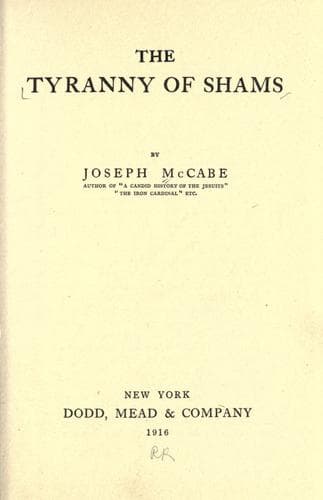
Great Britain -- Social conditions; Moral conditions; Social problems
If we agree that democracy will advance until the majority rule in
reality, and not merely in theory, these things must concern us. It is
of little use to point to the occasional periodical with small
circulation which endeavours to educate, to the occasional educative
column in more important journals, or to the occasional lecture or
serious concert or drama. The broad fact remains that our future
rulers are increasingly encouraged to refrain from mental cultivation,
to mistake an appeal to the imagination for knowledge, and to debase
their taste more and more with raw representations of crime and
passion. The working man reads with indignation of fashionable ladies
struggling to find a place in court when a man is being tried for a
series of sordid murders; and the working man then reads, day after
day, a three-column verbatim report of the trial, and regrets that
there is not more of it.
In order to meet this grave public need an earlier generation invented
night-schools and Mechanics' Institutes. Many of these still do
useful work, but their number shrinks rather than increases. The
Co-operative Movement, again, set up in the early days a fine ambition
to educate its adult members, but this ambition has not been generally
sustained in the vast modern movement. Hundreds of lecture-societies
were founded, and hundreds (about seven hundred in Great Britain, I
believe) exist to-day and do some excellent work; but many of the
societies which adhered most faithfully to the educational ideal are
in difficulties or extinct. The travel-lecture or funny lecture and
the "popular" concert encroach more and more on the serious
programme. Free libraries were another hope of the reformers of the
last generation, and they are now endowed by millionaires and
maintained by municipalities. They exhibit, perhaps, the saddest
perversion of social ambition. Neither Mr. Carnegie nor any serious
municipality thinks it a duty to provide gratuitous entertainment, but
at least two-thirds of their resources are really devoted to this. The
enormously greater part of the work of free libraries is to beguile
the idle hours of young men and the idle days of young women with
novels that rarely contain a particle of intellectual stimulation.
Public-domain text, read in full here on John Shaqi.
Reviews
Reviews
No reviews yet
Be the first to share your thoughts on this work.
Elsewhere in the archive
Join the Discussion
Join the discussion
Sign in to leave a comment or review.
Sign InorCreate an account