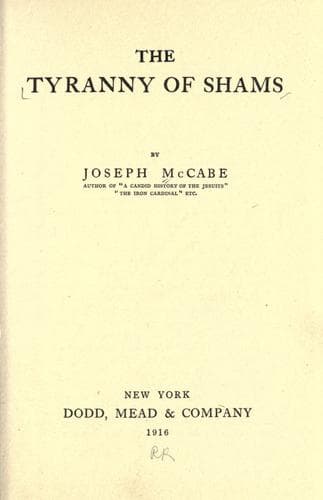
Great Britain -- Social conditions; Moral conditions; Social problems
And this fact dispenses me from the need to drag the reader into the
somewhat tiring labyrinth of proof and disproof which these warring
theologians have constructed. Nothing could be further from my mind
than the presumptuous and immodest wish to brand the clergy as
dishonest, and their beliefs as superstitious, because I happen to
regard those beliefs as false. Let the position be clearly understood.
A study of the _Hibbert Journal_ or any scholarly theological
periodical, or of any batch of learned theological works, will apprise
any person that what are ordinarily conceived to be the fundamental
positions of the Christian religion are challenged by a large
proportion of distinguished divines. Pleas of "reconstruction" are
constantly put before us; and at the Church of England Congress in
1912 it was plainly decided by the presiding Archbishop of York that
the "advanced" theologians had a legitimate place in the Church.
It is not a question of a few controverted points in the scheme of
Christian doctrine. No point that is specifically Christian is left
unchallenged. The divinity and miracles--especially the miraculous
birth and resurrection--of Christ, the prophecies, the doctrine of
heaven and hell, the divine guidance of the Church, the fall and
redemption of man--all these characteristic doctrines are gravely
disputed within the frontiers of the Churches themselves, wherever
freedom of expression is permitted.
One would prefer to rely on theologians only in such a matter, but for
my purpose it is not immaterial to add that outside the ranks of the
clergy scholarship is overwhelmingly against these doctrines. There
has been a good deal of unsubstantial talk about the beliefs of living
men of intellectual eminence, but resolute efforts have been made of
late years to wring from them a profession of Christian belief, and
the result has been so meagre that my statement is fully justified. A
large number declare that they are on the side of "religion." But
one has only to reflect that even Sir Oliver Lodge warmly professes to
be a Christian--and is, in fact, welcomed to read the lessons in
church--to see how little is conveyed by such expressions. The supreme
effort of the Churches to secure adhesions of this kind is probably
found in Mr. Tabrum's _Religious Beliefs of Scientists_ (1910), and
a study of that extraordinary jumble of the living and the dead, the
distinguished and the obscure, the really believing Christians and the
men who are notoriously not, will convince any person of the failure
of the Churches to obtain the literal adhesion of even a respectable
proportion of our distinguished men: not men of science merely--it is
a stupid error to suppose that the decay of faith is more or less
confined to them--but men of eminence in any department of research or
intellectual life. Not one in ten of them, in any educated country of
the Christian world to-day, has ever professed a belief in the
Public-domain text, read in full here on John Shaqi.
Reviews
Reviews
No reviews yet
Be the first to share your thoughts on this work.
Elsewhere in the archive
Join the Discussion
Join the discussion
Sign in to leave a comment or review.
Sign InorCreate an account