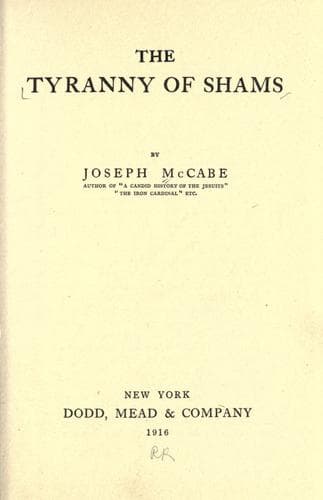
Great Britain -- Social conditions; Moral conditions; Social problems
We should thus remove the last serious obstacle to the reform, and the
work might advance rapidly. The tribunal, as I said, exists, and has
had more experience than is generally realised. The Hague Conference
of 1907 established a Prize Court, with permanent salaried judges, and
an Arbitration Court. A large number of very grave quarrels have since
been adjusted by this tribunal, and, as Professor Schücking observes,
"more than a hundred contracts between States have been concluded in
which, on each occasion, two States made the Arbitration Court
obligatory." But, largely owing to the opposition of Germany and the
general apathy, the Court remained optional, and the Powers maintained
their armies for the settlement of quarrels in the old barbaric
manner. The next and last step is for all the Powers to recognise the
Court as compulsory, and to furnish it with an executive (a small
international army and navy) for the enforcement of its decisions. Our
vast armies and navies then become superfluous and would be disbanded
simultaneously, leaving only a small force in each country for the
suppression of native aggression (with the consent of the Hague Court)
and for use by the Court itself to enforce its verdicts or suppress
illegal attempts to arm.
There is nothing Utopian or academic about this reform. A body of
high-minded lawyers and statesmen have for years discussed the details
of the scheme, and are ready to launch it whenever the various
Governments are compelled by public opinion to adopt it. The immediate
task is to create this pressure of public opinion. We may hope that,
after our ghastly lesson in the price of the military method, we shall
no longer be rebuffed with vapid phrases like: "Do not force the
pace." A business-man who talked nonsense of that kind would soon
find his level. We need to conduct our national and international life
on business-principles, to get rid as speedily as possible of a waste
and disorder which are an outrage on the intelligence of the race. I
look more confidently to business-men than to speech-making
politicians and sentimental moralists for the triumph of the reform.
Certain industries will, of course, be gravely dislocated, even
annihilated, by the change; and vast bodies of additional workers
will, in most countries, be thrown upon a crowded labour-market. From
the abstract economical point of view it is only a question of
transfer. Fifty millions which were spent on military industries will
now be used in enlarging other industries or creating new. In reality
there will be grave confusion; but that is due to the utterly
disorganised nature of our industrial world, which I discuss later. In
any case to allege this industrial difficulty as a serious reason
against disarmament is a very singular piece of folly. The cost and
trouble of adjusting this temporary dislocation would be infinitely
less than the cost and trouble of a war.
Public-domain text, read in full here on John Shaqi.
Reviews
Reviews
No reviews yet
Be the first to share your thoughts on this work.
Join the Discussion
Join the discussion
Sign in to leave a comment or review.
Sign InorCreate an account