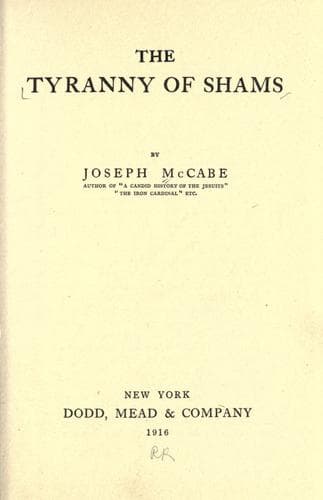
Great Britain -- Social conditions; Moral conditions; Social problems
There are two types of people into whose hands this book may fall. The
first is the man or woman whose nerves must not be disturbed by the
spectacle of the misery of less fortunate beings: who finds life good,
and instinctively resents any proposals to tamper with its
foundations. These people are no more open to blame, as a rule, than
the prophet is entitled to praise for his ardour. We do not choose our
temperament, whatever else we choose. But one does not appeal to these
comfortable people. They would have refined and pleasant things about
them always, and they shrink from the vaults where, they dimly know,
ugly and sordid and writhing things are crowded together: lest their
glance fall on some yellow and distorted face whose hollow cheeks, or
eyes bloodshot with pain or brutality, would disturb the even pleasure
of their lives. So be it. Let it be written in stark letters on their
marble stones, when the last peach has dropped from their relaxing
fingers: My ideal was to enjoy life, and to let the devil take the
hindmost.
Do not let me be misunderstood. The enjoyment of life is the supreme
ideal advocated in this book. I loathe asceticism, either Christian or
Stoic. But I write for the second type of man or woman: the people who
are strong and healthy enough to enjoy every pleasure that life
affords, yet keep some thought for the unhappiness of others: who
think it a normal part even of a pleasant and refined life, especially
a leisured life, to spare some hours for seeking how the world may be
improved for less fortunate folk: who, precisely because they love the
sunlight, ask if it cannot be devised that all men and women and
children shall have a larger share of it. Their chief difficulty is
that, unhappily, the new prophets are as discordant as the old. A few
centuries ago, when you crossed London Bridge, or the Pont Neuf at
Paris, or the Ponte Vecchio at Florence, a score of rival quacks or
charlatans (in the literal sense) cried in your ears the virtues of
their conflicting remedies. To-day just so many conflicting social
physicians cry their wares in the streets. They oppose each other
almost as bitterly as they oppose the older traditions. How shall a
busy man or woman decide among them? What fixed and unalterable
principle, in this world of dissolving creeds, can you adopt for the
testing of their truth or untruth?
Public-domain text, read in full here on John Shaqi.
Reviews
Reviews
No reviews yet
Be the first to share your thoughts on this work.
Join the Discussion
Join the discussion
Sign in to leave a comment or review.
Sign InorCreate an account