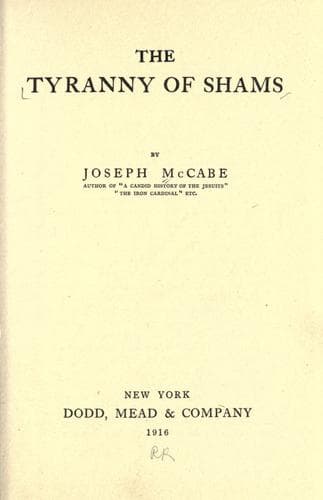
Great Britain -- Social conditions; Moral conditions; Social problems
The inevitable specialism of our age adds to the confusion. Life is a
connected whole, yet neither research nor reform can now be other than
sectional. We devote ourselves to a candid study of some particular
reform, and we find it a thoroughly reasonable proposal, a deduction
from principles that we are bound to admit. But we have not had
leisure to discover the indisputable principles of other reforms; and,
when we hear the demand of change and progress rising on one side
after another--in the Church, the State, the Home, the School, and so
on--we remark sententiously that rebellion is becoming a fashion, that
our generation is getting feverish or neurotic, that we must insist on
authority somewhere. We repeat plausible phrases about the decay of
respect and the wisdom of the race. We fasten on symptoms of
disorder--without inquiring very closely whether the disorder is new
or has been recently aggravated--and we conclude that conservatism is
a social duty: that, at all events, we will admit reform only by the
inch. We fancy ourselves the guardians of the _palladium_.
Quite apart from purely selfish motives, some of the closest observers
of our age do differ radically in diagnosis and prescription. The same
movements are symptoms of health to one man, symptoms of disease to
another. Take the enlargement of divorce, the decay of clerical
authority, the industrial revolt, or the rebellion of women. There
seems to be no common ground left on which the observers may meet with
any hope of agreement. The old religious and political standards will
now hopelessly divide any roomful of educated men and women. You
propose, perhaps, to fall back on moral standards--the ground on which
"all reasonable people" unite--and someone quotes against you half
a dozen of the most brilliant writers of Europe and America. Hopes and
lamentations, inspired by precisely the same facts of life, mingle
confusedly in our literature, and men and women of large heart and
little leisure seem to be condemned to a sterile perplexity or a
selfish absorption in business and pleasure. What, at all events, is
the meaning or purpose of life? And how is this spreading rebellion
related to it?
Public-domain text, read in full here on John Shaqi.
Reviews
Reviews
No reviews yet
Be the first to share your thoughts on this work.
Join the Discussion
Join the discussion
Sign in to leave a comment or review.
Sign InorCreate an account