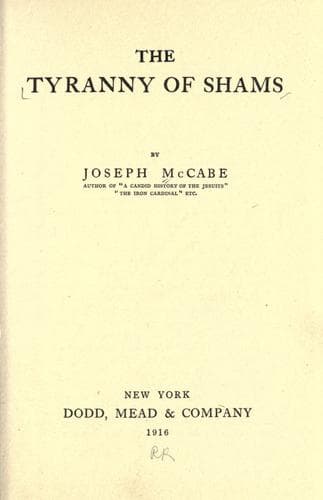
Great Britain -- Social conditions; Moral conditions; Social problems
I propose, however, to make a critical study of the family. Indeed, I
venture to say at once that our ideal of the family is so encrusted
with ancient superstitions that it pressingly invites the critical
attention of our age: that the family is the foundation of the State
only in an historical sense, not in the sense that a State cannot be
based on any other procreative arrangement: and that the cloak of
superstition and rhetoric that we have put about it has covered for
ages, and still covers, an appalling amount of vice, hypocrisy, and
misery. My point of view has been stated. The affairs of this planet
must be run by men for men. The supreme aim must be to lighten the
burden of suffering which we inherit from a less intelligent and less
humane past. Any creed, code, or institution which forbids progress on
these lines must be assailed.
The first and most damnable superstition in regard to the family is
the claim that marriage ought to be indissoluble. In its strict form
this belief is held only by Roman Catholics, and by a section of the
Church of England which was only partially reformed in the sixteenth
century and has a strange ambition to disavow even that limited
reform. But the most insidious mischief of this old ideal is that it
has embedded deep in our minds the feeling that, although indissoluble
marriage is an intolerable yoke, we must be very chary and niggardly
in granting relief. This feeling we ascribe to a wise concern for our
social welfare, whereas it is due to the subconscious tyranny of the
old superstition. Recently we have seen the strange spectacle of a
non-Christian moralist standing amongst our bishops to bar the way of
reform: seeking to prolong, in the name of humanity, a superstition
that darkens the homes of a large part of humanity. The bishops may
have smiled.
A distinguished sociological writer, Mr. L. Hobhouse, in classifying
forms of marriage, says, with unconscious humour: "Marriage is
indissoluble among the Andamanese, some Papuans of New Guinea, at
Watubela, at Lampong in Sumatra, among the Igorrotes and Italones of
the Philippines, the Veddahs of Ceylon, and in the Romish Church."
One trusts that the Roman (and Anglican) Catholics like the company
they keep; the peoples enumerated by Mr. Hobhouse are the very lowest
and least intelligent savages known to science. The Church of Rome has
long boasted that its ideal of indissoluble union is the final and
culminating point of human wisdom in regard to the family. It now
appears that indissoluble marriage was the most primitive human
tradition, and was discarded by the Roman and all other civilisations
when they passed from childhood to manhood.
Public-domain text, read in full here on John Shaqi.
Reviews
Reviews
No reviews yet
Be the first to share your thoughts on this work.
Elsewhere in the archive
Join the Discussion
Join the discussion
Sign in to leave a comment or review.
Sign InorCreate an account