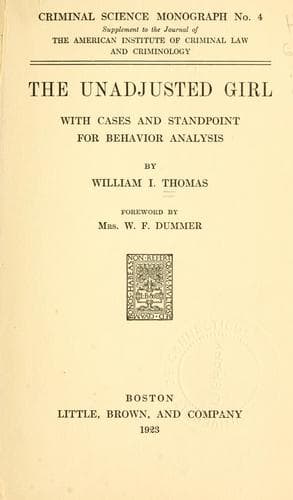
The Unadjusted Girl, With Cases and Standpoint for Behavior AnalysisThomas, William Isaac
Science
The Unadjusted Girl, With Cases and Standpoint for Behavior Analysis
Thomas, William Isaac
Female juvenile delinquents -- Case studies; Young women
June 9, 1913, woman in office in great distress; says Mary has not
worked at all at the hat factory [as she had pretended].... Has been
going with a girl who worked there. The girls say the employer is an
evil man and showed them a check book and said they could draw what they
liked.... Mary [refused to let him kiss her but] stole this check book
and on the 29th forged a check for $12 which she brought her mother
saying it was her pay. On the 2nd she forged another check for $11; $6
of this she gave to her mother and $5 she spent at Riverview Park....
July 29, 1913.... Probation officer says Mary lost her job on the 25th,
that one of the girls had loaned Mary a ring and when the time came for
Mary to restore it, Mary could not find it.... [A report from Kankakee
that Meyer had escaped was followed by a letter saying] “he escaped one
evening but returned of his own free will at bedtime and has since been
residing in the Institution.”...
January 17, 1914, Mary brought home $6 on the 14th but insisted upon $4
being returned to her, and with this she bought a very elaborate hat of
black velvet and gold lace. Talked with Mary. She was very defiant and
said that she would spend her money on clothing until she had something
to wear. Was not satisfied with the coat that United Charities had given
her from second-hand store. Said she would keep her money until she
could buy a new-style coat. Told her that if she did so the United
Charities would not help with food.
January 22, 1914, Mrs. Meyer in tears. The forelady at the shop where
Mary works telephoned that Mary had gotten married in court today....
Mary gave the date of her birth as December 18, 1895 [instead of 1896]
and signed the affidavit herself....
January 30, 1914, visited. Asked Mrs. Meyer to take a position....
Suggested Mary could stay and take care of the children.... Mary was at
first very unwilling to consent to the plan. While the visitor was there
Mr. Andersen [her husband] came in. He agreed to the plan at least
temporarily.
February 4, 1914, Mrs. Meyer in office. Says the work is too hard at the
present situation and she is not earning enough to feed the children.
Mary has had to give her money and she is ashamed and sorry. She feels
too nervous to work and wants United Charities to get Mr. Meyer out of
asylum to support her. Jennie, her niece, took her to visit him and she
found him nicely dressed and sober, doing teaming work. He promised
never to drink and to support the family.
Public-domain text, read in full here on John Shaqi.
Reviews
Reviews
No reviews yet
Be the first to share your thoughts on this work.
Elsewhere in the archive
Join the Discussion
Join the discussion
Sign in to leave a comment or review.
Sign InorCreate an account