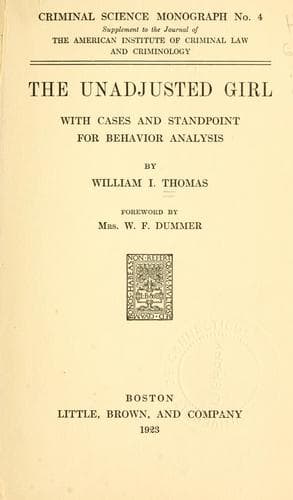
The Unadjusted Girl, With Cases and Standpoint for Behavior AnalysisThomas, William Isaac
Science
The Unadjusted Girl, With Cases and Standpoint for Behavior Analysis
Thomas, William Isaac
Female juvenile delinquents -- Case studies; Young women
A letter written by the United Charities June 16, 1914, states “We have
found her this spring in a peculiar mental condition due, we think, to
sheer discouragement and a feeling of having been defeated in life. All
of her home furnishings are dilapidated and of long usage, because of
her inability to replace them. She has been a woman who always took a
peculiar delight in her home and longed to have it furnished daintily so
that it did not compare so poorly with the homes where she has worked.
We feel now that if we might help her replenish her linen and some of
her household supplies we might be able to tide over their period of
discouragement and help her to feel that life was again worth
living....”
August 19, 1914, Mrs. Meyer and Mary in office. [Mary very well dressed
and living in her own apartment.] Mary says she has been helping her
mother continually with food and clothing. Her husband makes $19 a week
but she has to pay $17 rent and $5 a week for her furniture. She also
has to save money because she is now several months pregnant. Her
husband wishes her to have a doctor. She is planning to have a midwife
because it is cheaper. Advised her not do this.... During a period of
unemployment for her husband she refused to seek aid at her mother’s
suggestion as she felt too proud....
November 13, 1915. Tillie still earns $4.00 a week.... Must buy new
dress [refuses to wear dresses given by charity as being
old-fashioned—same as Mary]. For lack of satisfactory dress she has not
gone to church for 3 weeks. Mrs. Meyer fears she will slip away from
church unless allowed clothes she wants. Her [Mrs. Meyer’s] ideas become
more and more erratic. She said she wishes she were dead, had only
trouble.
For the past year the church [Irish, not Polish, for the latter always
demanded money instead of giving assistance] has had a decided influence
over Mrs. Meyer. Her children attend the parochial school and the priest
has taken a very active interest in their welfare.... The family lives
in a less congested district and although Mrs. Meyer is still very
nervous and frequently complains, the whole complexion of the family has
changed. She is very interested in a mothers’ cooking class started last
winter ... and is also being taught to write by her 12–year-old son....
If the man remains in Kankakee and the children keep well we feel sure
the family will eventually become self-supporting. It is surely the
highest point as far as the standard of living is concerned.... The
present system of County relief cannot but have a debasing effect upon
the family, particularly upon the children, who frequently must
accompany the mother in order to bring home the dole of inadequate
rations.... Mary is a good housewife and a sensible mother. She is
contented and happy and her ideals are considerably higher, due directly
to her husband.[93]
Public-domain text, read in full here on John Shaqi.
Reviews
Reviews
No reviews yet
Be the first to share your thoughts on this work.
Elsewhere in the archive
Join the Discussion
Join the discussion
Sign in to leave a comment or review.
Sign InorCreate an account