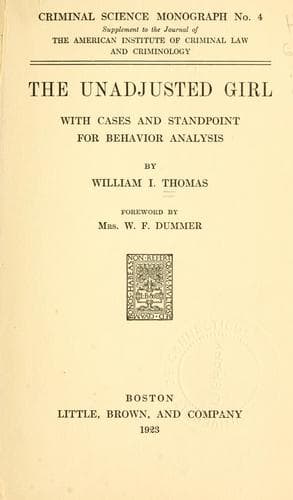
The Unadjusted Girl, With Cases and Standpoint for Behavior AnalysisThomas, William Isaac
Science
The Unadjusted Girl, With Cases and Standpoint for Behavior Analysis
Thomas, William Isaac
Female juvenile delinquents -- Case studies; Young women
A Girls’ Club was organized and a club house secured in the city for
about eighteen girls and their field secretary. The girls pay their
board and work in stores, industries, etc. The housework is done by one
girl, who is paid by the others to act as home-maker. It is called the
Los Angeles Business Girls’ Club and is sponsored by the Los Angeles
Business Women’s Club not as a charity, but as an act of coöperation on
the part of the business women with the younger and handicapped working
girls of the city. Not all the residents are wards of the court, the
chief requirement being that girls be under twenty-one years of age and
receiving the minimum wage. The club serves as meeting place for
organization of young people, business girls, college girls, etc. Thus
any element of isolation, or unlikeness, is at an end for the girl who
may be a ward of the court and she is brought into relationship with the
normal forces of the community.
The following four cases, selected because they serve to illustrate the
integrating processes at work in a socialized court procedure, may be
presented.
Evelyn is one. She is an orphan of Canadian extraction. Placed by a
children’s aid society in some six temporary homes, she readily drifted
into delinquency. For two years for her it was a succession of
institutions, tempered by probation, after she came under the court.
Then El Retiro was established. Her health was so delicate that she was
sent there for observation for anæmia. There her central ability was
discovered—leadership, and her chief interest the design and manufacture
of clothing. On graduation she became president of the alumnæ group of
girls and went to live at the club house. She began earning $22.00 per
week as designer and shortly plans to open a shop of her own. As
president of the alumnæ organization she has succeeded in doing what no
probation officer has done—the voluntary reporting of each girl’s change
of work, address, and new friends. If they are out of work through
indifference or indolence, her fluent scorn and her own stylish costume
act on them as a spur. Her activity has two major outlets, leadership
and craftsmanship.
Margaret is another: She was the oldest in a large family headed by a
dissolute factory operative and a quarrelsome, complaining mother. Her
home life was marked by coarseness and obscenity of language, and her
personality by alternate melancholy and violence. At El Retiro it became
apparently probable that her behavior was the reaction made by her
organism in seeking that which it really craved most, peace and
security. She became an El Retiro homemaker. A troublesome asthma
yielded to treatment based on quiet and contentment. She is now an
officer of the alumnæ club and she has returned to her own home, which
has largely become rehabilitated through her efforts. The club life
apparently affords her all she needs of contact with the outside world.
Public-domain text, read in full here on John Shaqi.
Reviews
Reviews
No reviews yet
Be the first to share your thoughts on this work.
Elsewhere in the archive
Join the Discussion
Join the discussion
Sign in to leave a comment or review.
Sign InorCreate an account