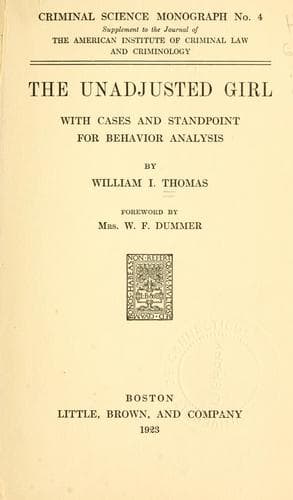
The Unadjusted Girl, With Cases and Standpoint for Behavior AnalysisThomas, William Isaac
Science
The Unadjusted Girl, With Cases and Standpoint for Behavior Analysis
Thomas, William Isaac
Female juvenile delinquents -- Case studies; Young women
1. The average school, like the old community, works on the assumption
of uniformity of personality and presents the same materials and plans
in the same order to all. The assumption is that children react in the
same way to the same influences regardless of their personal traits or
their social past, and that it is therefore possible to provoke
identical behavior by identical means. “Nature,” says Doctor Jennings,
“has expended all her energy in making our little flock of children as
diverse as she possibly can; in concealing within it unlimited
possibilities which no one can define or predict. It sometimes seems as
if we parents in our process of educating them were attempting to root
out all of these diversities, to reduce our flock to a uniform mass....
The only way in which appreciable progress can be made in the attempt is
by cutting off, stunting, preventing the development of the special and
distinctive qualities of the individuals. Unfortunately this can be done
to a certain extent, but only by a process which may be rightly compared
with the taking of human life.”[104]
2. The creative or plan-forming interest of the child is an expression
of the phase of new experience which is based on curiosity and appears
very early in the child. The child expresses his energy and secures his
recognition, favorable or unfavorable, mainly along this line. Response
and security do not mean so much to him as yet. The fact that the school
work is detached from activity and not related to the plan-forming and
creative faculty explains its failure to interest the child. An
investigator took five hundred children out of twenty factories in
Chicago and asked them this question: “If your father had a good job and
you did not have to work, which would you rather do, go to school or
work in a factory?” Of the five hundred children, between the ages of
fourteen and sixteen, 412 said they would rather work in a factory.[105]
In 1920 the White-Williams counselors in the Junior Employment Service
of the Board of Public Education interviewed 908 of the 10,674 children
who came that year to the Board of Public Education for general working
certificates. Forty-seven per cent of these did not want to go on with
their school work. They gave as reasons: “I was ‘left down’”; “I didn’t
like arithmetic”; “I was too tall for the other girls in the room”, etc.
Many of these difficulties might have been adjusted if some one could
have made plans with the children while they were still in school.[106]
Public-domain text, read in full here on John Shaqi.
Reviews
Reviews
No reviews yet
Be the first to share your thoughts on this work.
Elsewhere in the archive
Join the Discussion
Join the discussion
Sign in to leave a comment or review.
Sign InorCreate an account