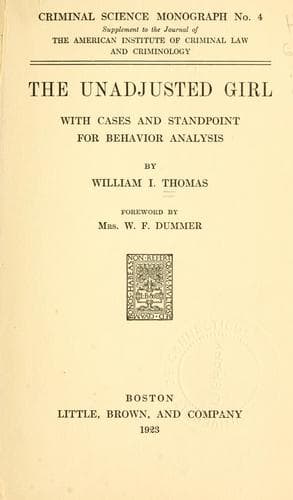
The Unadjusted Girl, With Cases and Standpoint for Behavior AnalysisThomas, William Isaac
Science
The Unadjusted Girl, With Cases and Standpoint for Behavior Analysis
Thomas, William Isaac
Female juvenile delinquents -- Case studies; Young women
3. There is therefore a question whether as a device for plan-forming by
presenting the right material and definitions at the right moment, the
school is not inferior to the world at large, at least when its
influences are protracted. The school presents indispensable
information, a technic for handling problems, such as reading, writing,
and ciphering, and presents the solution of the innumerable problems
which are already solved and which it is unnecessary to solve again. But
the school works injuriously on personality development and creative
tendencies. By presenting the whole body of cultural values in a
planless way, planless so far as schemes of personal development are
concerned, it tends to thwart and delay the expression of the
plan-making tendency of children until physiological maturity approaches
and the energetic, plan-forming, creative period is passed. The lives of
creative men show that they began their work early and did it by hook or
by crook sometimes by evading the schools, often by being the worst
pupils. The chemist Ostwald in his interesting book “Grosse Männer” has
pointed out that the precocity of such men as Leibnitz and Sir William
Thomson would have done them no good if the schools had been “better” in
their time.
In measuring the influence of the school we must recognize two types of
success in the adaptation of the individual to life, the one based on
his assertion and realization of wide and original claims, the other on
contentment with limited claims. If he is contented with claims which
are more limited than his powers justify, his adaptation is success
through relative failure. To the degree that the school treats children
as identical it produces a maximum number of relative failures. To some
extent the genius is regarded as a prodigy because so much spontaneity
is repressed by the school.
4. Clinicists and case workers who handle successfully difficult
children taken from the schools report that the schools tend to
accentuate rather than obviate the difficult features. Some of them feel
that where unsocial and neurotic tendencies have begun to appear through
bad family conditions the school is an additional influence for evil to
be overcome.
The school reaches practically every child and does its part in
deepening or lessening the neurotic tendencies. At present we are safe
in assuming that for the most part it deepens these tendencies. It
drives the neurotic child into truancy, vagrancy, anarchy, invalidism
and every form of delinquency or hardens its emotional reactions into
permanent moods, and it does all of this without in the least being
aware of it....
Public-domain text, read in full here on John Shaqi.
Reviews
Reviews
No reviews yet
Be the first to share your thoughts on this work.
Elsewhere in the archive
Join the Discussion
Join the discussion
Sign in to leave a comment or review.
Sign InorCreate an account