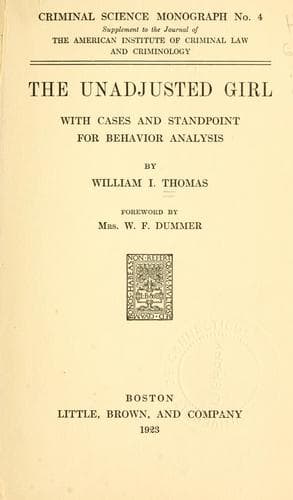
The Unadjusted Girl, With Cases and Standpoint for Behavior AnalysisThomas, William Isaac
Science
The Unadjusted Girl, With Cases and Standpoint for Behavior Analysis
Thomas, William Isaac
Female juvenile delinquents -- Case studies; Young women
Science accumulates facts and principles which could never be determined
by the common sense of the individual or community, and of so great a
variety and generality that some of them are constantly passing over
into practical life. The old farmer has learned the value of soil
analysis, though with reluctance and suspicion, and he has learned to
spray his orchards to preserve them from pests whose existence he did
not suspect. At this moment science is advising him to put a bounty on
the head of the turkey buzzard instead of imposing a fine for killing
it. His common sense had told him that the vulture was valuable as a
scavenger. Now science tells him that it is an ally of the paralysis fly
and carries cattle, hog, and other diseases over the country. “Probably
more than the income from a million dollars is spent each year in the
several marine biological institutions for the study of three lowly
forms,—the sea urchin and its progeny, the coral, and the jelly-fish.”
An American entomologist has spent many years in measuring the influence
of physical environment on potato bugs. He established colonies of these
insects in Mexico, moved them from one temperature to another, one
degree of humidity to another, one altitude to another, and recorded the
changes shown in the offspring. He then moved the new generations back
to the old environment and recorded the results,—whether the spots and
other acquired characters changed or remained. His object was to
determine certain laws of heredity,—whether and under what conditions
new species are produced, whether acquired characters are hereditary. To
common sense this procedure seems trivial, almost insane. But assuming
that a biologist determines a law of heredity, this will presumably have
a practical effect in the fields of agriculture, eugenics, crime, and
medicine.
These examples show that a science which results in a practical and
efficient technic is constituted by treating it as an end in itself, not
merely as a means to something else, and giving it time and opportunity
to develop along all the lines of investigation possible, even if we do
not know what will be the eventual applications of one or another of its
results. We can then take every one of its results and try where and in
what way they can be practically applied. We do not know what the future
science will be before it is constituted, and what may be the
applications of its discoveries before they are applied.
But, on the other hand, the scientist will naturally be influenced in
setting and solving his problems by the appreciation that if discoveries
are made in certain fields practical applications will follow. He may
know, for example, that if we can discover the scarlet fever germ we can
control this disease, and he may work on this problem, or he may suspect
that if we knew more of the chemistry of sugar we could control cancer,
and may work on that problem.
Public-domain text, read in full here on John Shaqi.
Reviews
Reviews
No reviews yet
Be the first to share your thoughts on this work.
Elsewhere in the archive
Join the Discussion
Join the discussion
Sign in to leave a comment or review.
Sign InorCreate an account