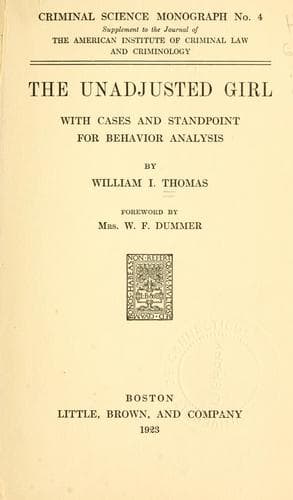
The Unadjusted Girl, With Cases and Standpoint for Behavior AnalysisThomas, William Isaac
Science
The Unadjusted Girl, With Cases and Standpoint for Behavior Analysis
Thomas, William Isaac
Female juvenile delinquents -- Case studies; Young women
Our best efforts to reform the delinquent, or even to control the
behavior of the young child in such a way as to secure a balanced,
efficient, creative, and happy schematization of life are very
imperfect. The juvenile court and the experimental schools do not
completely realize the hopes they inspired. The most careful methods may
result in failure and the most imperfect methods and even neglect of
method may result in, or at least not prevent success. We sometimes see
a poor, obscure, and underfed boy assuming a definite life-direction,
planning to be something, and pursuing his aim with the certitude of the
homing instinct, while a boy with the choicest opportunities of
life—money, schools, tutors, and travel—remains a nonentity or becomes
demoralized.
Now the example of the physical and biological sciences shows that the
human mind has the power to work out schemes which secure an adequate
control over the material world and over animal and plant life by a
series of observations and experiments which have been sufficiently
thorough and detailed to discover series of facts and their causal
connections which lead to the establishment of general chemical,
physical, mechanical, and biological _laws_, and the same objective
methods will lead to similar results in the field of social theory and
practice.
There is, indeed, no sharp line between the common-sense method of the
average man in determining facts and causal relations and the method of
the scientist. When we have found that a certain effect is produced by a
certain cause the formulation of this causal dependence has in itself
the character of a law; we assume that whenever the cause repeats itself
the effect will necessarily follow. The agriculture of the peasant and
of the old-fashioned farmer was scientific to the degree that they had
observed a causal relation between manure, lime, moisture, seasonal
changes, varieties of soils, animal and plant pests, and the success or
failure of their crops. But science is superior to common sense in its
methods of experimentation, measurement, and comparison, in its
isolation and intensive study of problems from mere scientific
curiosity, without regard to the practical application of its results.
Science is called cold because it is objective, seeking the facts
without regard to whether they confirm or destroy existing moral and
practical systems.
But science is always eventually constructive. A large number of
specialists working in many fields, upon detached and often apparently
trivial problems—primroses, potato bugs, mosquitoes, light, sound,
electricity, heredity, radium, germs, atoms, etc.—establish a body of
facts and relationships the social meaning of which they do not
themselves suspect at the time, but which eventually find an application
in practical life,—in agriculture, medicine, mechanical invention.
Public-domain text, read in full here on John Shaqi.
Reviews
Reviews
No reviews yet
Be the first to share your thoughts on this work.
Elsewhere in the archive
Join the Discussion
Join the discussion
Sign in to leave a comment or review.
Sign InorCreate an account