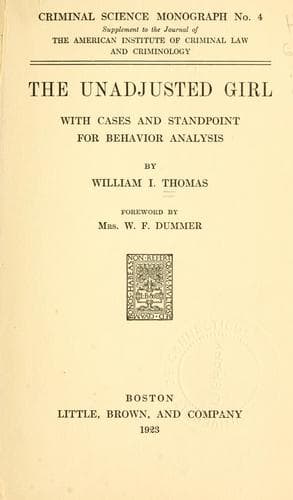
The Unadjusted Girl, With Cases and Standpoint for Behavior AnalysisThomas, William Isaac
Science
The Unadjusted Girl, With Cases and Standpoint for Behavior Analysis
Thomas, William Isaac
Female juvenile delinquents -- Case studies; Young women
The celebrated _Himmelsbriefe_ (correspondence with heaven) may be taken
as an example of an immoral scheme which is intellectually beyond
reproach. These letters are a pathetic and comic expression of the
ingenuity, artistic imagination, business enterprise and desire for
recognition of a young peasant girl. It will be seen that this
“correspondence” has a remarkable resemblance to the pages of Anatole
France; it lacks only the irony and the elaboration.
91. Cölestine Wurm, aged 13, was sick, bedridden, afflicted with
boils and oppressed by the feeling that she was a burden to her
parents. A neighboring family named Korn had lost a daughter named
Ursula. Cölestine represented that she had had a letter from the
dead daughter, who was then in purgatory and needed money to get
out. A sum was provided, 1,000 marks, and committed to Cölestine for
transmission. A letter was then received from Ursula describing
paradise, the joy of the saints, and how Mary, mother of Jesus, was
overjoyed with an oven Ursula had bought for her. In later letters
it appeared that Ursula was desirous of improving her status among
the saints and she requested money to buy a fine bed, some golden
buckets, kitchen utensils, etc., which were for sale dirt cheap.
Mary herself wrote a letter of appreciation to the parents of Ursula
informing them that they had been in danger of losing two valuable
cows through the machinations of the devil, but that out of
gratitude to Ursula and themselves, she had sent twenty angels to
guard them. Jesus also sent a letter, signing himself, “Your Son of
God, Jesus Christus.” First and last Cölestine collected 8,000 marks
on her enterprise.[110]
In more mature minds the socially unregulated scheme may be admirably
elaborated and executed, corresponding in ingenuity with the most
complete business or scientific plan and yet remain dangerously immoral
because its application is in a form not sanctioned by society. In the
following astonishing case we have an anti-social pursuit of a problem
executed with all the ardor and resources of a Pasteur. I call the case
astonishing because working under such handicaps, clandestinely,
stealing the values of society, this boy yet knew how to use these
values, the materials accumulated by society—the paper mill, the
library, the printing office—so much better than we have been able to
use them in an organized system of education. Pasteur’s scheme, and his
later schemes of the same pattern, were socially organizing because they
contributed to the development of medicine, agriculture, grape culture,
etc., while Wilken’s scheme was socially disorganizing and personally
demoralizing.
Public-domain text, read in full here on John Shaqi.
Reviews
Reviews
No reviews yet
Be the first to share your thoughts on this work.
Elsewhere in the archive
Join the Discussion
Join the discussion
Sign in to leave a comment or review.
Sign InorCreate an account