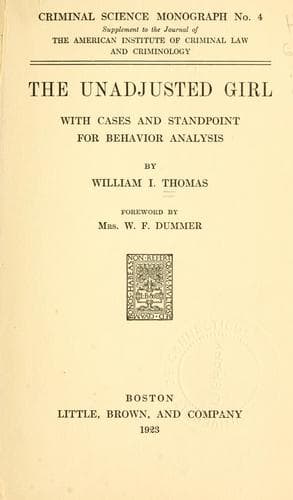
The Unadjusted Girl, With Cases and Standpoint for Behavior AnalysisThomas, William Isaac
Science
The Unadjusted Girl, With Cases and Standpoint for Behavior Analysis
Thomas, William Isaac
Female juvenile delinquents -- Case studies; Young women
It is, of course, precisely in this connection that the struggle between
the individual and his society arises. Society is indispensable to the
individual because it possesses at a given moment an accumulation of
values, of plans and materials which the child could never accumulate
alone. For example, a boy can now construct a wireless plant or build an
engine, but he could never in his life accumulate the materials, devise
the principles alone. These are the results of the experience of the
entire past of a cultural society. But the individual is also
indispensable to society because by his activity and ingenuity he
creates all the material values, the whole fund of civilization. The
conflict arises from the fact that the individual introduces other
definitions of the situation and assumes other attitudes toward values
than the conventionalized ones and consequently tends to change plans of
action and introduce disorder, to derange the existing norms. A new plan
may be merely destructive of values and organization, as when a
counterfeiter imitates a bank note or a girl destroys her value and that
of her family by prostituting herself, or it may be temporarily
disorganizing but eventually organizing, as when an inventor displaces
the hand-loom by the power-loom or the biologist introduces a theory of
evolution which contradicts the theory of special creation. Society
desires stability and the individual desires new experience and
introduces change. But eventually all new values, all the new cultural
elements of a society are the result of the changes introduced by the
individual.
If now we examine the plans of action carried out by children and men
with reference to social values, whether they are good or mischievous,
we find that the general intellectual pattern of the plan, the quality
of ingenuity, is pretty much the same in any case. When, for example,
children have escapades, run away, lie, steal, plot, etc., they are
following some plan, pursuing some end, solving some problem as a result
of their own definition of the situation. The naughtiness consists in
doing something which is not allowed, or in ways which are not allowed.
The intellectual pattern is the same whether they are solving a problem
in arithmetic, catching a fish, building a dog house, or planning some
deviltry. And the psychological pattern followed is the same as that
involved in the desire for new experience which I illustrated in
Pasteur’s pursuit of a problem, document No. 6, p. 10. From the
standpoint of _interest_ the nature of the problem and the means of its
pursuit and solution make no difference. The latter are moral questions.
Public-domain text, read in full here on John Shaqi.
Reviews
Reviews
No reviews yet
Be the first to share your thoughts on this work.
Elsewhere in the archive
Join the Discussion
Join the discussion
Sign in to leave a comment or review.
Sign InorCreate an account