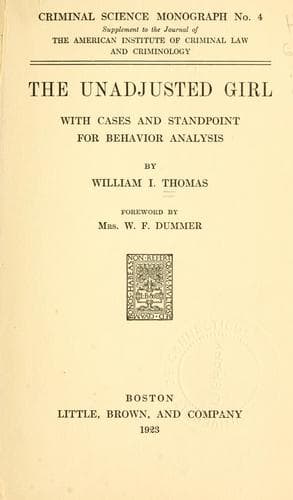
The Unadjusted Girl, With Cases and Standpoint for Behavior AnalysisThomas, William Isaac
Science
The Unadjusted Girl, With Cases and Standpoint for Behavior Analysis
Thomas, William Isaac
Female juvenile delinquents -- Case studies; Young women
Wilken went to that paper mill in Dalton three times. On each
occasion he went as a visitor, of course, and spent inside the mills
only the comparatively few minutes it takes the visitor to be
ushered from process to process and room to room. If you have ever
been conducted through an industrial plant you will realize how
little you actually see of processes....
Wilken left the paper mill convinced that he was quite ready to
start business. He moved to New York City and set up a studio at 250
West 125th Street. To make everything appear regular he got a job
with an advertising firm. He drew pictures of soap and suspenders,
and so on, and did rather good work arranging display type for
posters. That required only a small part of his time....
First he made the necessary paper. Just how well he worked will be
apparent in a few minutes. Then he set about utilizing his
book-learned etching and engraving. Little by little he added to his
equipment. He never used a camera. In this fact alone he stands
conspicuous among counterfeiters. So far as I know, he was the only
counterfeiter of any ability at all who did not first photograph the
bank note he was about to counterfeit and work from that.... [Then
he made one-dollar bills.] I must say to begin with that not all the
Wilken bills were detected. Really relatively few of them came into
our hands. We took several of the bills to the paper mill in Dalton.
They declared the paper to be genuine! We looked back over the
production records and checked them against consumption. The two
figures balanced! In other words, the United States Mint had used
all that had been produced. There seemed to be nothing to do but
watch the factory. For six months we hung around and nothing
happened.
In a month or so Wilken, so we learned later, decided it was time to
go to work again. He did. He set up a studio in West Twenty-third
Street, New York City, and began to turn out ten dollar bills that
passed the tellers of some of the most important banks in America.
They even passed the scrutiny of experts in the Treasury Department.
I have samples of them here. They are magnificent frauds. I have
never seen finer engraving.
And to think that he learned this engraving in a public
library.[111]
And there are many cases in the records of courts and prisons showing a
high degree of imagination, ingenuity, constructive intelligence,
artistic ability, and careers as long continued in crime as legitimate
life careers in physics, engineering, or art.
Public-domain text, read in full here on John Shaqi.
Reviews
Reviews
No reviews yet
Be the first to share your thoughts on this work.
Elsewhere in the archive
Join the Discussion
Join the discussion
Sign in to leave a comment or review.
Sign InorCreate an account