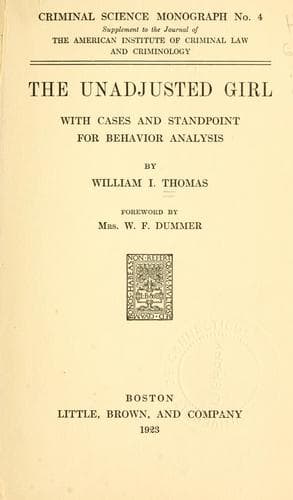
The Unadjusted Girl, With Cases and Standpoint for Behavior AnalysisThomas, William Isaac
Science
The Unadjusted Girl, With Cases and Standpoint for Behavior Analysis
Thomas, William Isaac
Female juvenile delinquents -- Case studies; Young women
93. Adrian Gorder, born in Holland, the son of a night watchman, set
about making of himself a counterfeit priest with as much
thoroughness as Wilken set about making counterfeit money. He
learned all the technique of the church service, including music and
church history, celebrated Mass perfectly, posed as member of
various religious orders, dressed richly, was poetic and plausible.
He visited, for example, Budapest, made certain representations of
himself to the clergy there, showed pictures of eminent
ecclesiastics and spoke of them as his friends. Talked intimately
about church affairs, celebrated Mass, borrowed money or cashed
worthless paper and disappeared. He was not so perfect a counterfeit
as Wilken’s bills because he had not completely mastered Latin as a
spoken tongue, but in spite of frequent incarcerations he operated
for twenty-five years over a large part of the world.[112]
All the types of wishes coexist in every person,—the vague desire for
new experience, for change, for the satisfaction of the appetites, for
pleasure; the new experience contained in a pursuit, as in the cases of
Pasteur and Wilken; the desire for response in personal relations
(“there was a girl Wilken liked and who liked him”); the desire for
recognition (Wilken was “ambitious for success, for wealth, for
position, for luxury”); and the desire for security,—the assurance of
the means and conditions for gratifying all the wishes indefinitely. And
all of these classes of wishes are general mental attitudes ready to
express themselves in schemes of action which utilize and are dependent
upon the existing social values. These values may be material, as when
Wilken used the library, the printing office, the paper mill, or they
may be the mental attitudes of others, as when a bogus nobleman imposes
on the desire for recognition of a bourgeois, or a scientist appeals to
a philanthropic person to endow an institution for medical research.
That is, the attitudes of one person are among the values of another
person.
The attitudes of a given person at a given moment are the result of his
original temperament, the definitions of situations given by society
during the course of his life, and his personal definitions of
situations derived from his experience and reflection. The character of
the individual depends on these factors.
Public-domain text, read in full here on John Shaqi.
Reviews
Reviews
No reviews yet
Be the first to share your thoughts on this work.
Elsewhere in the archive
Join the Discussion
Join the discussion
Sign in to leave a comment or review.
Sign InorCreate an account