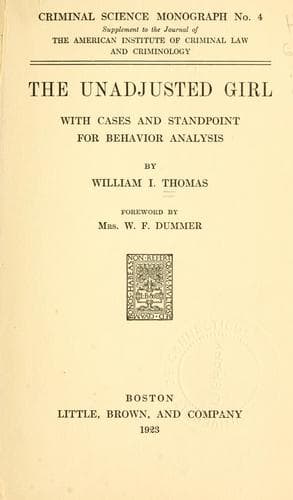
The Unadjusted Girl, With Cases and Standpoint for Behavior AnalysisThomas, William Isaac
Science
The Unadjusted Girl, With Cases and Standpoint for Behavior Analysis
Thomas, William Isaac
Female juvenile delinquents -- Case studies; Young women
There will be marked individual
differences in the material selected, in the length of time any
type of material will be utilized, and in the early constructive
habits which will arise with respect to all materials worked with
by the infant. Without instruction one infant (eighteen to twenty
months in an observed case) will build a neat wall with her
blocks, with one color always facing her. If the block is turned
while she is not looking she will quickly change it and correct
the defect. In other children such a bit of behavior can be
inculcated only with the greatest difficulty. Still another child
cannot be made to play with blocks but will work with twigs and
sticks by the hour. Variations in the selection and use of
material are the rule in infancy, but until we have followed up
the future course of such variations upon _infants whose past we
have watched day by day_ we are in no position to make
generalizations about the original tendencies which underlie the
vocations. (3) Finally, until we have obtained data upon the
emotional life of the infant and the normal curve of instinctive
and habit activity at the various ages, new methods for correcting
deviations in emotional, instinctive and habit development cannot
be worked out. Let us take a concrete example. A certain child is
afraid of animals of every type, furry objects, the dark, etc.
These fears are not hereditary. Our experiments will be convincing
upon that point. What steps can we take to remove these fears
which, unless they are removed in infancy, may become an enduring
part of the child’s personality?[113]
It will be seen that the Watsons are here studying attitudes—what ones
appear, in what order they appear, what ones are universal, and what
ones are particular to certain children. They introduce values—the
materials and influences—only as means of determining the presence of
attitudes, of calling them into action, of modifying them, and of giving
them application in different fields. They consciously introduce change
on the basis of some hypothesis and measure the effect of the new
influences on personality development. Already in this brief passage and
this unfinished experiment they indicate methods of determining (1)
occupational aptitudes, (2) defective mental efficiency, (3) the age
levels at which influences are to be presented and the order of their
presentation, and (4) the conditions of stable or neurotic
personalities. Their task is the measurement of influence under
conditions which they prepare and control. All scientific
experimentation involves the measurement of influence. The chemist
measures the influence of a material, say coal tar; the technician uses
this influence in preparing a dye or a medicine. The measurement of the
influence is the definition of the situation preliminary to action.
Public-domain text, read in full here on John Shaqi.
Reviews
Reviews
No reviews yet
Be the first to share your thoughts on this work.
Elsewhere in the archive
Join the Discussion
Join the discussion
Sign in to leave a comment or review.
Sign InorCreate an account