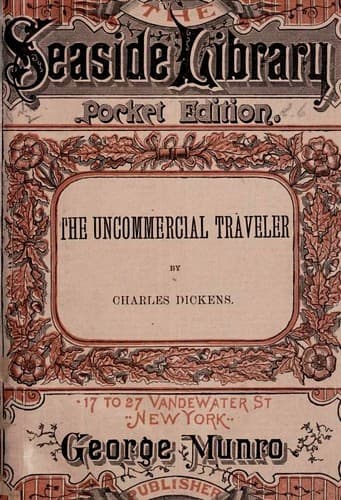
Great Britain -- Social conditions -- 19th century; London (England) -- Description and travel
No landlord is my friend and brother, no chambermaid loves me, no waiter
worships me, no boots admires and envies me. No round of beef or tongue
or ham is expressly cooked for me, no pigeon-pie is especially made for
me, no hotel-advertisement is personally addressed to me, no hotel-room
tapestried with great-coats and railway wrappers is set apart for me, no
house of public entertainment in the United Kingdom greatly cares for my
opinion of its brandy or sherry. When I go upon my journeys, I am not
usually rated at a low figure in the bill; when I come home from my
journeys, I never get any commission. I know nothing about prices, and
should have no idea, if I were put to it, how to wheedle a man into
ordering something he doesn’t want. As a town traveller, I am never to
be seen driving a vehicle externally like a young and volatile pianoforte
van, and internally like an oven in which a number of flat boxes are
baking in layers. As a country traveller, I am rarely to be found in a
gig, and am never to be encountered by a pleasure train, waiting on the
platform of a branch station, quite a Druid in the midst of a light
Stonehenge of samples.
And yet—proceeding now, to introduce myself positively—I am both a town
traveller and a country traveller, and am always on the road.
Figuratively speaking, I travel for the great house of Human Interest
Brothers, and have rather a large connection in the fancy goods way.
Literally speaking, I am always wandering here and there from my rooms in
Covent-garden, London—now about the city streets: now, about the country
by-roads—seeing many little things, and some great things, which, because
they interest me, I think may interest others.
These are my chief credentials as the Uncommercial Traveller.
II
THE SHIPWRECK
NEVER had I seen a year going out, or going on, under quieter
circumstances. Eighteen hundred and fifty-nine had but another day to
live, and truly its end was Peace on that sea-shore that morning.
So settled and orderly was everything seaward, in the bright light of the
sun and under the transparent shadows of the clouds, that it was hard to
imagine the bay otherwise, for years past or to come, than it was that
very day. The Tug-steamer lying a little off the shore, the Lighter
lying still nearer to the shore, the boat alongside the Lighter, the
regularly-turning windlass aboard the Lighter, the methodical figures at
work, all slowly and regularly heaving up and down with the breathing of
the sea, all seemed as much a part of the nature of the place as the tide
itself. The tide was on the flow, and had been for some two hours and a
half; there was a slight obstruction in the sea within a few yards of my
feet: as if the stump of a tree, with earth enough about it to keep it
from lying horizontally on the water, had slipped a little from the
land—and as I stood upon the beach and observed it dimpling the light
swell that was coming in, I cast a stone over it.
Public-domain text, read in full here on John Shaqi.
Reviews
Reviews
No reviews yet
Be the first to share your thoughts on this work.
Join the Discussion
Join the discussion
Sign in to leave a comment or review.
Sign InorCreate an account