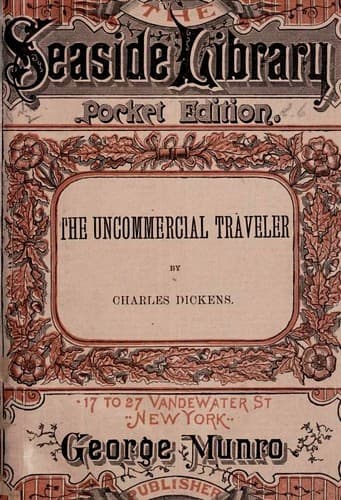
Great Britain -- Social conditions -- 19th century; London (England) -- Description and travel
think of it, the wonder is, that every working-day pervader of these
scenes goes clean away. The man who sells the dogs’ collars and the
little toy coal-scuttles, feels under as great an obligation to go afar
off, as Glyn and Co., or Smith, Payne, and Smith. There is an old
monastery-crypt under Garraway’s (I have been in it among the port wine),
and perhaps Garraway’s, taking pity on the mouldy men who wait in its
public-room all their lives, gives them cool house-room down there over
Sundays; but the catacombs of Paris would not be large enough to hold the
rest of the missing. This characteristic of London City greatly helps
its being the quaint place it is in the weekly pause of business, and
greatly helps my Sunday sensation in it of being the Last Man. In my
solitude, the ticket-porters being all gone with the rest, I venture to
breathe to the quiet bricks and stones my confidential wonderment why a
ticket-porter, who never does any work with his hands, is bound to wear a
white apron, and why a great Ecclesiastical Dignitary, who never does any
work with his hands either, is equally bound to wear a black one.
XXIV
AN OLD STAGE-COACHING HOUSE
BEFORE the waitress had shut the door, I had forgotten how many
stage-coaches she said used to change horses in the town every day. But
it was of little moment; any high number would do as well as another. It
had been a great stage-coaching town in the great stage-coaching times,
and the ruthless railways had killed and buried it.
The sign of the house was the Dolphin’s Head. Why only head, I don’t
know; for the Dolphin’s effigy at full length, and upside down—as a
Dolphin is always bound to be when artistically treated, though I suppose
he is sometimes right side upward in his natural condition—graced the
sign-board. The sign-board chafed its rusty hooks outside the bow-window
of my room, and was a shabby work. No visitor could have denied that the
Dolphin was dying by inches, but he showed no bright colours. He had
once served another master; there was a newer streak of paint below him,
displaying with inconsistent freshness the legend, By J. MELLOWS.
My door opened again, and J. Mellows’s representative came back. I had
asked her what I could have for dinner, and she now returned with the
counter question, what would I like? As the Dolphin stood possessed of
nothing that I do like, I was fain to yield to the suggestion of a duck,
which I don’t like. J. Mellows’s representative was a mournful young
woman with eye susceptible of guidance, and one uncontrollable eye; which
latter, seeming to wander in quest of stage-coaches, deepened the
melancholy in which the Dolphin was steeped.
This young woman had but shut the door on retiring again when I bethought
me of adding to my order, the words, ‘with nice vegetables.’ Looking out
at the door to give them emphatic utterance, I found her already in a
state of pensive catalepsy in the deserted gallery, picking her teeth
with a pin.
Public-domain text, read in full here on John Shaqi.
Reviews
Reviews
No reviews yet
Be the first to share your thoughts on this work.
Elsewhere in the archive
Join the Discussion
Join the discussion
Sign in to leave a comment or review.
Sign InorCreate an account