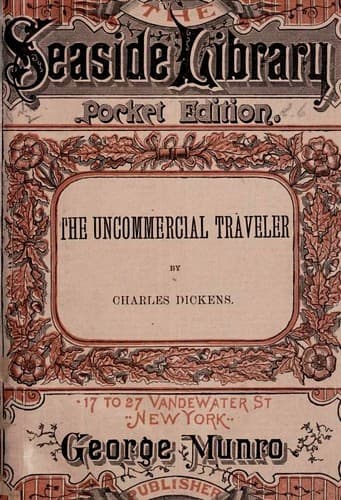
Great Britain -- Social conditions -- 19th century; London (England) -- Description and travel
out, with no visible neck, and with his eyes going before him like a
prawn’s. This causes the sniggerers to regard flight as an eligible
move, and I know which of them will go out first, because of the
over-devout attention that he suddenly concentrates on the clergyman. In
a little while, this hypocrite, with an elaborate demonstration of
hushing his footsteps, and with a face generally expressive of having
until now forgotten a religious appointment elsewhere, is gone. Number
two gets out in the same way, but rather quicker. Number three getting
safely to the door, there turns reckless, and banging it open, flies
forth with a Whoop! that vibrates to the top of the tower above us.
The clergyman, who is of a prandial presence and a muffled voice, may be
scant of hearing as well as of breath, but he only glances up, as having
an idea that somebody has said Amen in a wrong place, and continues his
steady jog-trot, like a farmer’s wife going to market. He does all he
has to do, in the same easy way, and gives us a concise sermon, still
like the jog-trot of the farmer’s wife on a level road. Its drowsy
cadence soon lulls the three old women asleep, and the unmarried
tradesman sits looking out at window, and the married tradesman sits
looking at his wife’s bonnet, and the lovers sit looking at one another,
so superlatively happy, that I mind when I, turned of eighteen, went with
my Angelica to a City church on account of a shower (by this special
coincidence that it was in Huggin-lane), and when I said to my Angelica,
‘Let the blessed event, Angelica, occur at no altar but this!’ and when
my Angelica consented that it should occur at no other—which it certainly
never did, for it never occurred anywhere. And O, Angelica, what has
become of you, this present Sunday morning when I can’t attend to the
sermon; and, more difficult question than that, what has become of Me as
I was when I sat by your side!
But, we receive the signal to make that unanimous dive which surely is a
little conventional—like the strange rustlings and settlings and
clearings of throats and noses, which are never dispensed with, at
certain points of the Church service, and are never held to be necessary
under any other circumstances. In a minute more it is all over, and the
organ expresses itself to be as glad of it as it can be of anything in
its rheumatic state, and in another minute we are all of us out of the
church, and Whity-brown has locked it up. Another minute or little more,
and, in the neighbouring churchyard—not the yard of that church, but of
another—a churchyard like a great shabby old mignonette box, with two
trees in it and one tomb—I meet Whity-brown, in his private capacity,
fetching a pint of beer for his dinner from the public-house in the
corner, where the keys of the rotting fire-ladders are kept and were
never asked for, and where there is a ragged, white-seamed,
out-at-elbowed bagatelle board on the first floor.
Public-domain text, read in full here on John Shaqi.
Reviews
Reviews
No reviews yet
Be the first to share your thoughts on this work.
Elsewhere in the archive
Join the Discussion
Join the discussion
Sign in to leave a comment or review.
Sign InorCreate an account