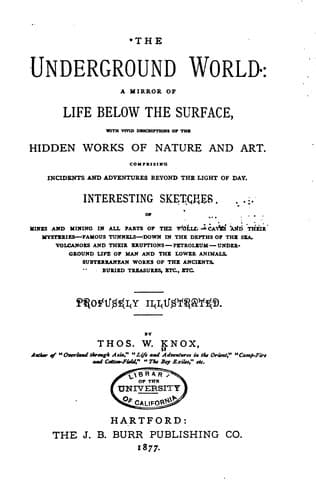
The Underground World: A mirror of life below the surfaceKnox, Thomas Wallace
History
The Underground World: A mirror of life below the surface
Knox, Thomas Wallace
Caves; Mines and mineral resources; Social history -- 19th century; Tunnels
We walked through streets silent and deserted, except by groups of
visitors like ourselves, and the occasional patrolmen or guides.
We walked on the pavement where, two thousand years ago, chariots
rolled along, and we saw on those pavements the marks of the chariot
wheels as plainly as if they had been worn during the past month.
At the drinking fountains on the street corners, we could see where
the Pompeian stopped when he was thirsty. The stone at the orifice,
whence the water poured out, was worn away by the many applications of
Pompeian lips.
[Sidenote: SCENES IN THE STREET.]
We looked into the ovens as they were on the day of the eruption.
The bakers were preparing their store of bread, and we were shown
the loaves which had been drawn from those ovens after resting there
eighteen hundred years. We saw the shops of the wine merchants, the
butchers, the bakers, and the men of other occupations.
We saw the names that had been painted on the door-posts, a little
faded and dull, yet still legible. We sat down on benches which
were unoccupied for seventeen hundred years; and we entered the
dwelling-houses where, two thousand years ago, the members of the
family passed their daily life. It was a picture of the past, and not
of the present.
Pompeii was preserved, and not destroyed. To its inhabitant, on the
day of the eruption it was destroyed; but for us who now look upon it,
and study its history, it has been preserved.
The most complete bakery in Pompeii was in Herculaneum Street, and
occupied an entire house.
The inner court-yard of the house contains four mills of curious
construction. At a little distance they resemble hour-glasses. Imagine
two large blocks of stone in the shape of cones, the upper one overset
upon the lower, and you have their construction.
The lower one remained motionless, and the other was turned either
by a man or a donkey. The grain was crushed between the two stones.
Sometimes the servants of the establishment turned the mill. At other
times slaves, for some misdemeanor, had their eyes put out, and then
they were sent to work at grinding.
The story goes that, sometimes, when the millers were short of hands,
they established bathing-houses around their mills, and the passers
by who were caught in the trap had to work the mill. In the
establishment now referred to, the machinery was turned, not by men,
but by a mule, whose bones were found lying near. In the stable of the
mule the racks and troughs were standing. Near the bake-ovens were the
troughs where the dough was kneaded.
There was one oven which remained uninjured. It had two openings; the
loaves went into one of these, in the shape of dough, and were taken
out at the other opening baked. Everything seemed to be in a fine
state of preservation, and the oven could be made use of again for a
repetition of its work of eighteen centuries ago.
[Illustration: DISCOVERY OF LOAVES OF BREAD BAKED 1800 YEARS AGO, AT
POMPEII.]
[Sidenote: STALE BREAD.]
Public-domain text, read in full here on John Shaqi.
Reviews
Reviews
No reviews yet
Be the first to share your thoughts on this work.
Elsewhere in the archive
Join the Discussion
Join the discussion
Sign in to leave a comment or review.
Sign InorCreate an account