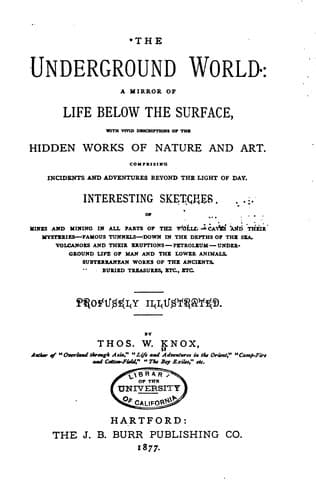
The Underground World: A mirror of life below the surfaceKnox, Thomas Wallace
History
The Underground World: A mirror of life below the surface
Knox, Thomas Wallace
Caves; Mines and mineral resources; Social history -- 19th century; Tunnels
The oven when found was full of bread. Some of the loaves were stamped
to indicate that they were of wheat flour, and others to indicate that
they were of bran flour. The oven had been carefully sealed, and there
were no ashes in it. Eighty-one loaves were found in it, a little
stale, to be sure, and very hard and black, but lying in the same
order in which they were placed on the 23d of November in the year 79.
The loaves weighed about a pound each. They are round, depressed in
the centre, raised on the edges, and divided into eight lobes. Imagine
an American pie which has been marked with the knife as if for cutting
before it is placed in the oven, and you have an almost exact picture
of a Pompeian loaf of bread. I did not try to eat it, partly because
I prefer my bread fresh, and partly because the loaves are considered
too precious to be given or sold to visitors.
Whoever goes to Pompeii thinking to find a perfect city will be very
much disappointed.
The ruins of Pompeii, as the old lady said about the ruins of the
Coliseum, are very much out of repair. The walls of the buildings
are mostly standing, but the roofs and doors, which were constructed
of wood, are gone, having rotted away in their long exposure to the
moisture. Everything whatever, of wood, planks, or beams, was turned
to ashes: all is uncovered, and there are no roofs to be seen.
Almost everywhere you walk under the open sky; everything is open, and
if a shower were to come on, you would hardly find shelter. Imagine
yourself in a city in process of building with only the first stories
completed, and with no floorings for the second.
[Sidenote: ART IN POMPEII.]
Many of the statues and works of art have been carried to the Museum
at Naples, so that in the old city itself, there are, comparatively,
few curiosities of a portable character. The sky, the landscape, the
sea-shore, the walls and the pavements are antique, and it is only
the visitors and their guides that are modern. The streets are not
repaired, the sidewalks are not changed, and we walk upon the same
stones that were formerly trodden by the feet of the Pompeian merchant
and his slave.
As we enter these narrow streets we can almost think we are quitting
the century we live in, and going back to the century that witnessed
the birth of Christ.
When first uncovered, the paintings of the walls were as fresh as
though they were made but a week ago, the ashes having preserved them
perfectly. In a few weeks or months their coloring fades, and they
become dingy and hardly visible.
The Pompeians were great lovers of art; every wall is frescoed, and
the mosaics on the floors are an interesting study. Statues adorn
the interior of the dwellings, and abound in the public places: even
the ordinary utensils of the kitchen were fashioned in a remarkable
manner, and far more artistic than those of the present day. The most
ordinary utensils of the household are specimens of art that evoke the
admiration of every beholder.
Public-domain text, read in full here on John Shaqi.
Reviews
Reviews
No reviews yet
Be the first to share your thoughts on this work.
Elsewhere in the archive
Join the Discussion
Join the discussion
Sign in to leave a comment or review.
Sign InorCreate an account