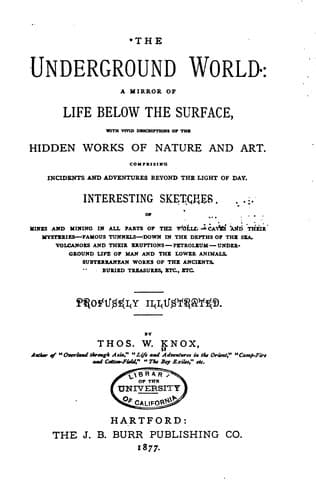
The Underground World: A mirror of life below the surfaceKnox, Thomas Wallace
History
The Underground World: A mirror of life below the surface
Knox, Thomas Wallace
Caves; Mines and mineral resources; Social history -- 19th century; Tunnels
As one walks through Pompeii he sees much to tell him that advertising
is not altogether an invention of the present age. Placards and
posters enlivened the streets; the walls were covered with them; and
in many places there were whitewashed patches of wall, serving for
the announcements which the writers wished to make public. These
panels were dedicated entirely to the public business, and anybody had
the right to paint upon them, in delicate and slender letters, the
advertisements which we now find in the columns of the newspapers.
[Sidenote: ADVERTISING IN THE OLDEN TIME.]
Many of these announcements were of a political character, such as
proclamations of candidates for public office. Pompeii was evidently
swallowed up just before an election. In reading the posters you will
find that sometimes it was a noble, sometimes a group of citizens,
and sometimes a corporation of tradesmen, who recommended some one
to the office of _ædile_ or _duumvir_. Thus Paratus nominates Pansa;
Philippus nominates Caius; Felix, and Valentinus, and his associates
prefer Sabinus. Sometimes the elector was in a hurry, and asked to
have his candidate chosen quickly. Sometimes a dozen guilds, such
as the fruiterers, the porters, the mule drivers, the salt makers,
carpenters, and others, united to urge the election of somebody.
Rather curiously, we found on some of these placards that the sleepers
declared their preference for somebody, and it puzzled us to know who
were these friends of sleep. Perhaps they may have been gentlemen who
did not like noise, or perhaps they were an association of tumultuous
fellows who thus disguised themselves under an ironical title. They
may have been a type of the class who are described in the present
slang of New York as _roosters_.
There were advertisements of lost property, hotels announcing rooms to
let, stolen horses, performances at the theatres, and various other
things, such as we see in the advertising papers, and in posters on
the walls at the present day.
There were some of these posters devoted to what we call _personals_.
Of course they were obscurely worded, so as to be understood only by
those for whom they were intended. One of my companions asserted that
one advertisement read, “Julia, same place, six P. M., Tuesday;” and
another said, “Scipio, come back; all will be forgiven;” and another
was, “Marcus has gone west, will return next week.”
I did not see these advertisements, and make the statement only on
his authority. I might have been inclined to believe it had he not
declared, with the most solemn visage, that he read an advertisement
thus: “Secure me a suit of rooms on the Boston steamer to-morrow.”
This was too much; and I told him that business was played out.
There were inscriptions in reference to the cleanliness of the
city; and some of them recalled, in terms too precise and definite
for modern times, the announcement of the present day, “Commit no
Nuisance.”
Public-domain text, read in full here on John Shaqi.
Reviews
Reviews
No reviews yet
Be the first to share your thoughts on this work.
Elsewhere in the archive
Join the Discussion
Join the discussion
Sign in to leave a comment or review.
Sign InorCreate an account