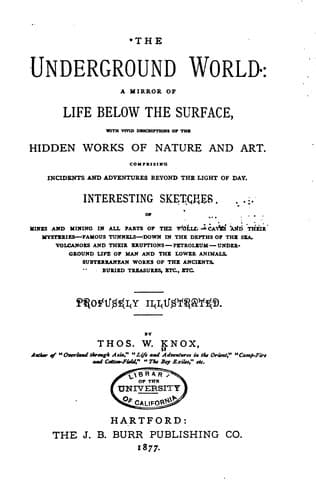
The Underground World: A mirror of life below the surfaceKnox, Thomas Wallace
History
The Underground World: A mirror of life below the surface
Knox, Thomas Wallace
Caves; Mines and mineral resources; Social history -- 19th century; Tunnels
We enter the house by the _vestibulum_, or hall, and come into the
_atrium_, a large square, paved with marble, inlaid with the richest
mosaic of various colors. A row of pillars, adorned with the most
beautiful freschi, border it on the right and left, and between them
doors may be seen, which lead into bedrooms. The two last rooms on the
sides of this open space leave two small recesses, which are furnished
in the richest manner, and probably served as small reception-rooms.
In the center of this _atrium_ is an _impluvium_, or small reservoir,
generally provided with a fountain. Over this impluvium the roof
is open, and the sky may be seen. Going onward, right opposite the
entrance, we enter into the _tablinum_, which is not provided with a
door, and allows a free view over the _atrium_. This room probably
served for a large reception-room, as the most costly paintings and
the richest furniture are found here. On the right-hand side of this
room we find the _triclinium_, or dining-room, and on the other
side a cabinet of curiosities and gems is found. Between this last
apartment and the reception-room, a small passage is seen, which
probably served for the slaves, as they were not allowed to go through
the reception-room of their master. These rooms all open on the
peristyle, another oblong square, which has on either side a row of
sleeping-rooms, which probably were destined for the afternoon nap of
the old Romans. No beds are to be seen in them, only large, commodious
lounges.
[Sidenote: DESCRIPTION OF A HOUSE.]
At the end of this peristyle, which also is adorned with pillars and
statuary, and we may readily except flowers and plants of the richest
fragrance, we enter into a second eating-room, for the Romans had
one dining-hall for the winter, and one for the summer, or one for
ordinary, and another for festive occasions. A cabinet, dignified
with the name of library, is, in most cases, on the right-hand side
of this room, and in these apartments have been found many rolls
of papyrus (the reader will remember that the art of printing was
not invented before the fifteenth century after Christ), containing
manuscripts. On the other side was generally the kitchen. From this
last eating-room we enter into the _viridarium_, or garden. Modern
imagination can scarcely imagine the beauty and luxury of this cool
place of resort. Fountains of fragrant waters here filled the air with
sweet perfume, and we do not wonder that this place was devoted to a
rest after dinner, and the abode of love. The wall, which terminates
the garden and the house, is screened by the most beautiful plants,
which overshadow superb statuary, and we may imagine the beautiful
view which may be had from the _atrium_, through the different rooms
(as no doors interfere) to the green background, variegated by the
colors of flowers and the rich curtains, whose folds partly conceal
the _tablinum_ and the second dining-room.
Public-domain text, read in full here on John Shaqi.
Reviews
Reviews
No reviews yet
Be the first to share your thoughts on this work.
Elsewhere in the archive
Join the Discussion
Join the discussion
Sign in to leave a comment or review.
Sign InorCreate an account