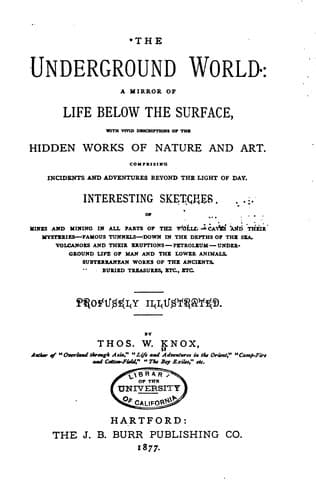
The Underground World: A mirror of life below the surfaceKnox, Thomas Wallace
History
The Underground World: A mirror of life below the surface
Knox, Thomas Wallace
Caves; Mines and mineral resources; Social history -- 19th century; Tunnels
The houses consist generally of one single floor, unless they are
very large, and we may easily see, from the plan here described, that
there is space enough for the comfort of all the inhabitants, and the
enjoyment of the numerous guests.
[Sidenote: ANCIENT PAINTINGS.]
If we wished to give a description of all the treasures found in
those ancient abodes, we might fill volumes, and therefore we will
only mention some of the most remarkable features of the recent
excavations. One picture has been exhumed at Pompeii, representing
the Three Graces, which Raphael, of course, could not possibly have
seen, yet the two compositions, although of different dimensions,
are precisely the same—in grouping, in form, in expression, and
even in charm. Now, not even a sketch of the picture was known
until long after the middle of the eighteenth century, while the
actual picture is a modern revelation altogether. Another fact was
discovered: Raphael, copying a statue, applied the very same process
to his painting which had been employed by his predecessors fifteen
centuries previously. Within the last few years, forty figures have
been redeemed from out these artistic tombs, which were evidently
details of an immense composition, intended for the adornment of a
theater or banqueting-hall, besides those, pictures of lightly-clad
figures, floating through the air, relieved against brown, black, and
crimson skies, with masses of carnation-cloud beneath their feet,
and gems hanging, so to speak, around them, enveloped in robes of
hyacinth, blue, green, and so on, the colors appearing to be laid
thickly on vitrified surfaces. It is a wonder to all artists how those
colors were laid on, not only as far as the magnificent coloring goes,
but even in what way it was done. We find painting in relief on the
smoothest surface of white marble; statuary even has been painted in
the most masterly way, and we see auburn and blonde hair painted in
a way which deceives even the sharpest observer; if we did not know
better, we would think that the statue had natural hair,—all the gloss
and the true tinge glowing through it is illustrated to absolute
perfection.
The Neapolitan chemists, of course, are very eager to unravel this
secret of their forefathers. Many a piece of painting has been
analyzed; many a fragment of painted beauty has been destroyed by
acids. However, till now, they did not succeed, and perhaps the art
will be for ever a mystery to us.
Public-domain text, read in full here on John Shaqi.
Reviews
Reviews
No reviews yet
Be the first to share your thoughts on this work.
Elsewhere in the archive
Join the Discussion
Join the discussion
Sign in to leave a comment or review.
Sign InorCreate an account