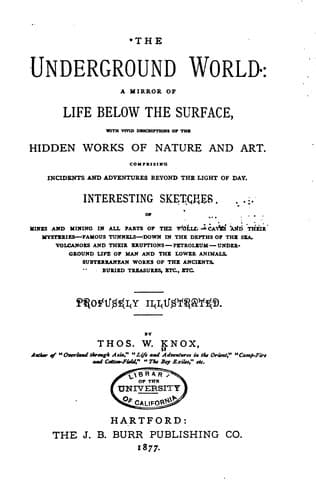
The Underground World: A mirror of life below the surfaceKnox, Thomas Wallace
History
The Underground World: A mirror of life below the surface
Knox, Thomas Wallace
Caves; Mines and mineral resources; Social history -- 19th century; Tunnels
The eruption of Vesuvius that buried Pompeii destroyed Herculaneum at
the same time. Some historians contend that the occurrences were not
identical in point of time; but, after all, it makes little difference
to us whether the two cities were simultaneously destroyed or not. The
probability is, and it is pretty well settled, that while the ashes
and stones from the crater of Vesuvius were blown upon Pompeii, the
lava and mud flowed in the direction of Herculaneum, and covered it. A
third city, Stabiæ, was destroyed at the same time—a fact which is not
generally known. Castellamare, a well-known summer resort near Naples,
stands on the site of Stabiæ, whose excavations, not having promised
very well, were filled up soon after they were begun.
The lava which flows from a volcano during violent eruptions is a
composition of melted stone and oxide of iron. The stone is mainly
feldspar and hornblende. There is a good deal of sulphur also in the
lava when it rises in the volcano, but the most of it is thrown out in
the form of sulphurous fumes. The lava very much resembles the slag or
scoriæ flowing from an iron foundery, and, when suddenly cooled, it
assumes a glassy character. When it consolidates or cools, it forms
what are known as volcanic rocks. If the streams of lava are cooled
under no other pressure than that of the atmosphere, they assume a
porous appearance. Lava, cooled under the surface of the water is much
more compact, and where it is cooled under heavy masses of earth and
rock, it becomes quite solid.
[Sidenote: STARTING FOR VESUVIUS.]
Our party visited Herculaneum after making a journey to Vesuvius.
We wished to see the volcano first, and afterwards to explore the
city which it had destroyed. We rode out of Naples, after our usual
struggle with the hackman, and at Resina left our carriage to proceed
on horseback. About half the population gathered to see us off. A
staff, or heavy stick, is considered indispensable, and each of us
purchased one from the crowd of boys and men, whose wooden material
was sufficient for starting a small forest. I think our selection
was made from about two hundred and forty-seven sticks, which they
simultaneously presented in our faces, and with the demands of the
venders and the piteous appeals of forty or fifty beggars, we had, for
a few minutes, a concord of sweet Italian sounds.
As soon as we had bought the sticks we used them to clear away the
crowd, and as we were all young, reasonably powerful, and as indignant
as we were powerful, we made a clear circle around us in a very short
time. Then we bargained for animals on which to ride. I obtained a
horse, something like those with which the famous Mackerel Brigade was
equipped.
[Sidenote: REMARKABLE STEEDS.]
Public-domain text, read in full here on John Shaqi.
Reviews
Reviews
No reviews yet
Be the first to share your thoughts on this work.
Elsewhere in the archive
Join the Discussion
Join the discussion
Sign in to leave a comment or review.
Sign InorCreate an account