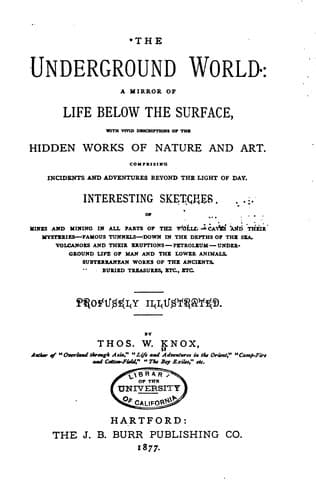
The Underground World: A mirror of life below the surfaceKnox, Thomas Wallace
History
The Underground World: A mirror of life below the surface
Knox, Thomas Wallace
Caves; Mines and mineral resources; Social history -- 19th century; Tunnels
Upon the whole, as this antique city is thrown more and more open to
modern light, it proves to be the richest memorial extant of Grecian
genius, as represented by an art so different from, and still at the
same time so kindred to, sculpture. In most other classic centers,
while the form and the purity have survived, the color and the
splendor have faded; but here, as chamber after chamber, gallery after
gallery is opened, a new beauty of the past appears, freshly vivified
by the long-excluded light, and, as we are assured, labyrinths of
interest remain yet to be explored.
[Sidenote: AN ANCIENT WINE-SHOP.]
A wine-shop was lately found at Pompeii, roughly ornamented with
imitations of marbles in fresco. Over the podium of the front room
runs a band of stucco, with four groups or scenes painted on a white
ground. The first, on the left, represents a young man kissing a
woman dressed in yellow garments, with black shoes. She says, “Nolo,
cym myrta” * * “I don’t want to be kissed; go to your Myrtalis.”
The second scene represents, very likely, the same woman talking to
Myrtalis, who says, “Non mia, est.” They both point their fingers at a
third female, bringing in a great wine-jar and a glass. She says, “Qui
vol. symat oceane, veni. bibe,” an invitation to partake of the drink.
The third scene represents two gamblers seated, having the chess-board
on their knees, on which several latrunculi are seen disposed in rows
of different colors, yellow, black, white. The one on the left is
just throwing the dice, and says, “Exsi,” “I won.” The other answers,
pointing to the dice, “Non tria, duas est,” “You have got two, not
three.” Both fight in the fourth scene. One says, “Non it a me, tria,
ego, fvi,” “I did not throw two, but three. I have won.” The other
answers, “Orte fellator ego fvi,” “You ——! I have the game.” At this
moment the shop-keeper comes in, and pushing them outside, says,
“Itis, foras, riksatis,” “Go out to quarrel.”
XII.
VESUVIUS AND ITS ERUPTIONS.
THE GREAT ERUPTION OF VESUVIUS.—WHAT IT DID.—THREE CITIES WIPED
OUT.—LAVA AND ITS CHARACTER.—GOING TO THE MOUNTAIN.—SKIRMISHING
WITH GUIDES AND BEGGARS.—ARCHITECTURAL STEEDS.—A HORSE WITH A
HAND RAIL AROUND HIM.—COAT-HOOKS TO LET.—A MOTLEY CROWD.—HOW
AN AMERICAN WAS MOUNTED.—A NEW MODE OF SPURRING.—THE ROAD FROM
RESINA.—BURNING LAVA.—CROSSING THE LAVA BEDS.—CLIMBING ON
FOOT.—HAPS AND MISHAPS.—AN ENGLISHMAN’S ACCIDENT.—LIGHTING A
CIGAR AT THE CRATER.—SUFFOCATED BY SULPHUR FUMES.—DOWN AMONG THE
ASHES.—A LONG FALL AND SLIDE.—IN HERCULANEUM.—UNDERGROUND BENEATH
THE CITY.—“LOOK HERE.”—HOW THE CITY WAS DISCOVERED.—THE ERUPTION
OF 1872.—HORRIBLE SCENES.—EXTENT OF THE DESTRUCTION.
Public-domain text, read in full here on John Shaqi.
Reviews
Reviews
No reviews yet
Be the first to share your thoughts on this work.
Elsewhere in the archive
Join the Discussion
Join the discussion
Sign in to leave a comment or review.
Sign InorCreate an account