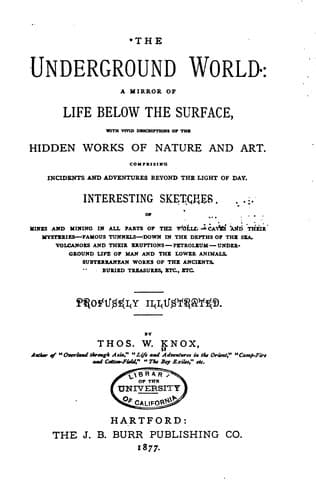
The Underground World: A mirror of life below the surfaceKnox, Thomas Wallace
History
The Underground World: A mirror of life below the surface
Knox, Thomas Wallace
Caves; Mines and mineral resources; Social history -- 19th century; Tunnels
Going down the mountain was much easier than going up. We did not go
down at the same place where we made the ascent, but went a little
to one side, where we could walk down through the ashes. The first
step or so is a little trying to the nerves, but after two or three
steps you acquire confidence and then let yourself out. All you need
to do is to stand erect, throw your head back, and start off, putting
one foot before the other in a dignified sort of way. The ashes are
generally dry and dusty, but at the time of my descent they had just
been moistened by a slight fall of rain, so that no dust arose from
them. Our feet settled in the ashes up to the ankles, and at every
step we went forward six or eight yards. It took us an hour and a
quarter to climb the mountain, and we came down in seven minutes,
including a halt on the way to make love to an English girl, who had
slipped, and was unable to pick herself up. We assisted her to her
feet, and lost a minute or two in our work of gallantry.
[Sidenote: RACING IN THE LAVA BEDS.]
A countryman of ours who attempted to come down just behind us was
not quite as successful as ourselves. He managed to pitch forward and
turn a very pretty somersault; but the exercise did not improve his
personal appearance or his temper. When he brought himself to rights,
and reached the place where the horses were standing, he was very much
dilapidated, and as cross as a bear with a chewed ear.
It is hard work to ascend Vesuvius, but it is jolly fun to come down.
[Illustration: DESCENT OF VESUVIUS.]
We mounted our animals and came away. On the steepest part of the
descending road, we tried to get up a race, thinking that the laws of
gravitation would help us. Part of the beasts were induced to run, but
there were two or three out of which no speed could be made faster
than a walk. Even a descent as steep as the roof of an ordinary house
had no temptations for them, and I wanted to try the experiment of
flinging them over a precipice, to see whether they could be started
into anything like a respectable pace. I have my doubts about it; and
had they been flung from a perpendicular cliff, I think they would
have come down through the air as majestically and as calmly as a
parachute descends from a balloon.
When we reached Resina, we rode to Herculaneum. The modern discovery
of this city resulted from digging a well in the year 1709. The site
of the city had been lost, owing to the great depth—nearly one hundred
feet—of the solid material which covered it. Properly speaking,
Herculaneum was destroyed by liquid mud, rather than by burning lava.
Since the destruction of the city, there have been six different
overflows of lava, so that for all practical purposes the site is
covered with this solid material.
Public-domain text, read in full here on John Shaqi.
Reviews
Reviews
No reviews yet
Be the first to share your thoughts on this work.
Elsewhere in the archive
Join the Discussion
Join the discussion
Sign in to leave a comment or review.
Sign InorCreate an account