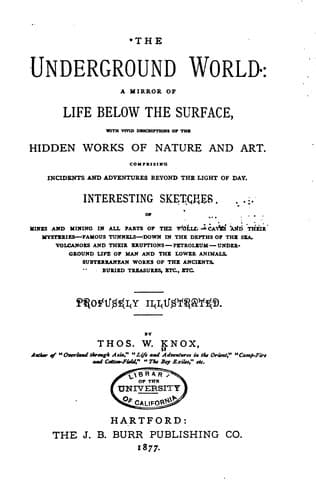
The Underground World: A mirror of life below the surfaceKnox, Thomas Wallace
History
The Underground World: A mirror of life below the surface
Knox, Thomas Wallace
Caves; Mines and mineral resources; Social history -- 19th century; Tunnels
When the well referred to was being made, the workmen came upon
another well; an ancient affair, nearly eighty feet from the surface.
Several works of art were brought to light, but for some reason
the government of Naples prohibited the explorations. Thirty years
later, they have been renewed, and have since been prosecuted at
different intervals. At the present time the excavations are continued
with much zeal, and startling discoveries are being made.
[Illustration: SEARCHING FOR RELICS AT HERCULANEUM.]
As was the case with Pompeii, so over ancient Herculaneum a new
city has been built. Underground passages have been explored like
those of a mine, without uncovering them to the light of day. One
great difficulty of the excavations exists in the fact that whilst
Pompeii, at the time of the great eruption, was covered with ashes,
Herculaneum was covered with liquid lava, which, if not exposed to the
air, requires sometimes two or three years to cool off, but then it
is almost as hard as flag-stone. It is easily to be seen that under
such difficulties the excavations but slowly progressed; the more so,
as the digging has to be done very carefully, so as not to mar the
relics, for which the excavation properly is done.
It is not often that articles are found at a height above four feet
from the floor, as their weight naturally carried them downwards
through the soft mass of ashes. The digging is therefore rapidly
prosecuted until the uniform above level has been attained. After
this, the workmen carefully examine every piece of lava which they
extract by small portions. As soon as the experienced eye of any
worker recognizes the indications of a mold being formed in the lava,
labor near that point is stopped, and tamping irons are cautiously
inserted to make two or three vents in the cavity. Then liquid plaster
is poured in; and after being left sufficiently long to harden, the
lava is taken away, and the cast is removed.
[Sidenote: A YOUNG MAN AND A YOUNG LADY.]
In this way some curious facts have been brought to light. Two
skeletons were found in close embrace, the teeth perfect, indicating
youth in its prime; skeletons of a young man and maid. They had
fallen together in their flight, and death had wedded them. There
was a mother with her three children, hand-in-hand, who tried vainly
to outrun death. Perhaps the mother, singly, might have done it, but
she could not leave her children. Plenty of food for sad thought is
furnished in remembering that at Herculaneum and Pompeii, six hundred
skeletons have already been exhumed!—many in such positions and
circumstances as to suggest very touching episodes accompanying the
final catastrophe.
The skeleton of a dove was found in a niche overlooking the garden
of a house. She had kept to her post, notwithstanding the shower of
hot, death-dealing lava. She sat on her nest through all the storm,
shielding the egg which was taken from beneath her.
[Sidenote: THE STREETS OF HERCULANEUM.]
Public-domain text, read in full here on John Shaqi.
Reviews
Reviews
No reviews yet
Be the first to share your thoughts on this work.
Elsewhere in the archive
Join the Discussion
Join the discussion
Sign in to leave a comment or review.
Sign InorCreate an account