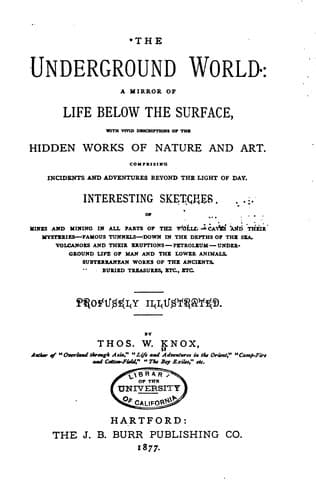
The Underground World: A mirror of life below the surfaceKnox, Thomas Wallace
History
The Underground World: A mirror of life below the surface
Knox, Thomas Wallace
Caves; Mines and mineral resources; Social history -- 19th century; Tunnels
The streets of Herculaneum are all paved with lava, just as the
streets of Naples are paved to-day. One street is more than thirty
feet wide, and furnished with raised sidewalks. The houses were
mostly of brick, and in general appearance and structure like
those of Pompeii, which we described before. Magnificent pieces
of art were taken out of them, but it is to be deplored that the
paintings, as a rule, fade as soon as they are exposed to the
light of day. Many statues and busts and pieces of furniture claim
our highest admiration; they are admirably executed, and evince a
highly-cultivated taste. Various musical and surgical instruments, and
boxes, and many utensils belonging to the kitchen and toilet, call our
attention, especially those of the kitchen, the utensils being very
variegated, and mostly manufactured of copper lined with silver. Many
imitations of precious stones have been found; they naturally excite
the curiosity of the chemist, who is eager to know how the old Romans
produced them. Most of these articles are now exhibited in the Museum
of Naples, where the paintings are kept under glass, which precaution
prevents the fading of the brilliant colors as much as possible.
Herculaneum possessed a theater, which claims our greatest attention,
as it is the most important building discovered. It was able to
contain eight thousand persons. Its walls are highly decorated, and
its floors and pillars were constructed of different colored marble.
[Sidenote: SIGNOR FIORELLI.]
Signor Fiorelli, the Italian engineer who supervises the excavations
at Herculaneum and Pompeii, claims that Pompeii did not contain more
than 12,000 inhabitants at the time of the eruption, although it
has generally been supposed that the population was from 20,000 to
50,000.
[Illustration: THE GATE OF HERCULANEUM AND STREET OF TOMBS.]
Eight gates have been discovered, and the roads outside of them are
lined on each side with tombs of considerable size and architectural
pretension. The street of tombs, before the gate of Herculaneum, was
probably the principal burial place of the city; and the sepulchral
monuments adorning it, give evidence of the refined taste and great
wealth of the prominent inhabitants. The streets, which, for the most
part, run in regular lines, are, with some exceptions, barely wide
enough to admit a single vehicle. Five of the main streets have been
partially or wholly traced, and with these a regular system of minor
streets appear to have been connected. The thoroughfares, with a
single exception, terminate in or traverse the western quarter of the
city, which is the only part yet completely explored.
Public-domain text, read in full here on John Shaqi.
Reviews
Reviews
No reviews yet
Be the first to share your thoughts on this work.
Elsewhere in the archive
Join the Discussion
Join the discussion
Sign in to leave a comment or review.
Sign InorCreate an account