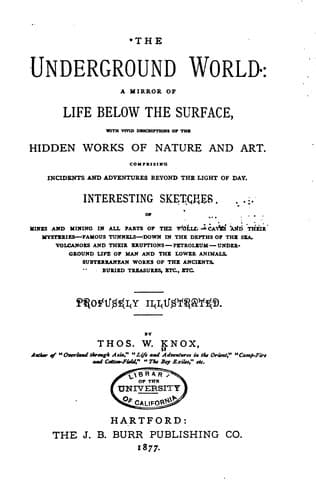
The Underground World: A mirror of life below the surfaceKnox, Thomas Wallace
History
The Underground World: A mirror of life below the surface
Knox, Thomas Wallace
Caves; Mines and mineral resources; Social history -- 19th century; Tunnels
We paid our admission fee, and then prepared according to the
directions of the guide. We laid aside our coats and vests, removed
our collars, neck-ties, and hats, and altogether put ourselves in
a condition quite improper in polite society. A boy stood ready to
precede us in a costume consisting of a pair of pantaloons and a tin
pail. A fresh egg was now shown us, and we examined it to see that it
was quite cold and raw. The boy then took the egg and a torch, and
went into a tunnel like the one at the Sibyl’s Cave. A blast of hot
air met us at the entrance, as though it came from a furnace, and I
thought of Nebuchadnezzar and the treat that he used to have for his
visitors. On and on we went, and also down and down. Old Virgil was
right when he said that the descent was easy, for we went down with
the grace of so many oysters entering the mouth of a champagne bottle.
Hotter and hotter grew the air, and before we were half way down I
remembered some business that I had neglected when I left America.
I wanted to go back to look after it, but my friends argued that it
would keep a little longer, and I had better go on. So we continued
down into the bowels of the mountain, over a slippery pathway and in a
temperature as agreeable as that of the stoker’s room on a steamship.
We reached the end at last, and the boy stooped to the edge of a pool
of water and placed the egg within it. We could see a thin vapor
rising from the surface, and readily imagined that it was steam. The
boy was careful of his hands, more careful than was necessary, since
he might have added to the interest of the occasion by scalding them,
and then hiring another boy to take his place. There were plenty of
boys outside who could be hired cheap, and if a dozen were killed
daily by scalding, or rendered helpless, it would have made no serious
diminution of the Italian population.
[Sidenote: FACILIS DESCENSUS AVERNI.]
We stood there a couple of minutes, and then the boy took the tin pail
and scooped up the egg and a quart or two of water. He then started
back, and scrambled quite nimbly up the steep and slippery path. It
was a difficult ascent to make, and we acknowledged that Virgil’s head
was level when he told about the labor required to retrace one’s steps
from Avernus. We perspired like a man who has just learned that he is
the father of triplets, and by the time we completed the journey, our
clothing was pretty thoroughly saturated. The boy was accustomed to
it, as the old lady’s eels were to being skinned, and the hide on his
shirtless back looked like the outside of a long-used pocket-book. The
egg was thoroughly cooked, and the water in the pail was of a scalding
temperature, altogether too hot to put one’s hand into. The egg cost
us half a franc, and so did the boy: one of us ate the egg with a
little salt, but we declined to eat the boy with or without salt, and
he did not urge us.
Public-domain text, read in full here on John Shaqi.
Reviews
Reviews
No reviews yet
Be the first to share your thoughts on this work.
Elsewhere in the archive
Join the Discussion
Join the discussion
Sign in to leave a comment or review.
Sign InorCreate an account