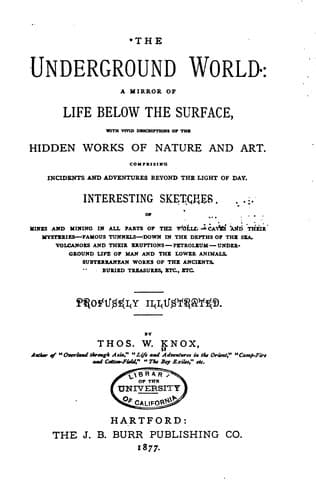
The Underground World: A mirror of life below the surfaceKnox, Thomas Wallace
History
The Underground World: A mirror of life below the surface
Knox, Thomas Wallace
Caves; Mines and mineral resources; Social history -- 19th century; Tunnels
The guide told us that one day an Englishman went down the “descensus
Averni,” and on arriving at the hot water, he stepped around so
carelessly that he slipped and fell in. His cries and shrieks rang
through the tunnel; he was pulled out as quickly as possible, but he
was so badly scalded that he died in a few hours. Several accidents
have happened there by persons scalding their hands and feet, but the
character of the place is such, that people are likely to be careful;
otherwise there would be frequent casualties to record.
[Sidenote: NERO’S PRISON.]
We visited the ruins of temples that were erected to I don’t know
how many deities, and the next subterranean exploration that we made
was at Nero’s Prison, as the guide and the guide-books call it. We
left our carriage and went on foot up a narrow lane, and along a path
where beggars followed and beset us at every turn; notwithstanding
their importunity, they did not extract any money from us, though they
appeared in all the conditions in which beggars could possibly present
themselves. Nero must have been a charming personage if one could
judge of him by looking at the place where he used to shut up those
who offended him. It was a subterranean affair, and we were obliged to
light our torches to explore it. We were led through winding passages
into cells that were anything but comfortable, the guide stopping
every moment to explain to us the nature of each one of the cells, and
the uses to which they were put. They were small enough to render it
utterly improbable that a man would exert his legs very actively in
running, after he was once shut in, and as for light and ventilation,
they were quite in keeping with the size of the apartments.
I inquired about the character of the food which Nero used to furnish
to the occupants of his boarding-house, and was told that it was not
of a luxurious character. Nero had no _table d’hôte_, but used to send
the meals to the rooms of his guests. None of them are alive now, and
their early death is to be attributed in many cases to the treatment
they received. At the time they resided there, oysters had not been
invented, and there is nothing on record to show that the delicious
conglomerate which we call hash had made its appearance. Some of the
patrons used to express a desire to live on the European plan, and
take their meals outside; but the proprietor would never permit it.
And it must be said, to his credit, that his establishment was to a
certain extent a free lunch concern, as he never charged anything for
board and lodging. Everything was gratis, and of course the patrons
who complained must have been mean fellows, who couldn’t be satisfied,
no matter what you might do for them.
[Sidenote: CHOICE FURNITURE.]
Public-domain text, read in full here on John Shaqi.
Reviews
Reviews
No reviews yet
Be the first to share your thoughts on this work.
Elsewhere in the archive
Join the Discussion
Join the discussion
Sign in to leave a comment or review.
Sign InorCreate an account