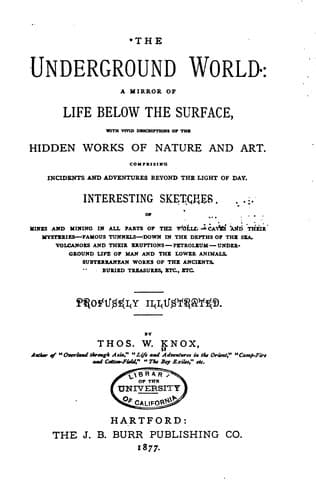
The Underground World: A mirror of life below the surfaceKnox, Thomas Wallace
History
The Underground World: A mirror of life below the surface
Knox, Thomas Wallace
Caves; Mines and mineral resources; Social history -- 19th century; Tunnels
which seem to run at full gallop; one of the warriors is holding a
bow in his hand, and has just shot an arrow at a stag. The stag is
wounded, and in anguish turns his head. The other seal ring represents
a warrior who has just vanquished his three enemies, and is in the
act of giving, with his uplifted sword, a last blow to one of them,
wounded, and kneeling before him on one knee; the latter tries to
parry the blow with his uplifted hands and with a lance, which he
holds in his right, and seems to throw at his opponent. Another seems
to be mortally wounded, for he lies on the ground, leaning on both his
hands. The third, who alone of all the four warriors has a helmet with
a crest on his head, is flying under the cover of an enormous shield
which reaches from his neck to his heels; but still he turns his head
towards his victorious enemy, and is in the act of throwing a lance at
him. The anatomy of all the men is so well observed, their posture is
so faithful to nature, and everything is executed with so much art,
that when I brought to light these rings, I involuntarily exclaimed:
‘The author of the ‘Iliad’ and the ‘Odyssey’ can only have been born
and educated in a civilization which could produce such wonders. Only
a poet who had master-pieces of art like these continually before his
eyes could compose those divine poems.’
[Sidenote: WONDERFUL GEMS.]
“At the head of one of the bodies was found a large and heavy golden
helmet, but it had been much crushed, and had become nearly flat under
the ponderous weight which pressed upon it. In its present state, it
is difficult to describe it. On its forepart, the openings for the
eyes and mouth, as also a protuberance ornamented with small stars,
are distinctly visible, as also on the top of the helmet, the tube for
the crest. The back part is beautifully ornamented with an imitation
of the hair. The face of the same body was covered with one of the
golden masks which we frequently met with. It seems to have been the
custom with the ancient Greeks, to cover the faces of their beloved
dead, with masks of gold which exactly represent the outline of the
features; probably they did so to preserve the face. We find this
custom back in the wooden masks of the Egyptian mummies. The breast
and sides were covered by a one-foot eight-inch long, and one-foot
broad, thick plate of gold, which was no doubt intended to represent
the coat of mail. There were further found one hundred leaves of
gold, either of circular or of cross-like form, with impressed
ornamentation, consisting either of spiral lines, or of circles.
Further, three very heavy golden breast-pins, of which the one is five
and one-half, the other five, and the third four and one-half inches
long. The last is crowned with a ram, the two others with an ornament
in shape of a helmet, and the heads of all the three breast-pins are
perforated, probably to put in a flower. There were further found two
Public-domain text, read in full here on John Shaqi.
Reviews
Reviews
No reviews yet
Be the first to share your thoughts on this work.
Elsewhere in the archive
Join the Discussion
Join the discussion
Sign in to leave a comment or review.
Sign InorCreate an account