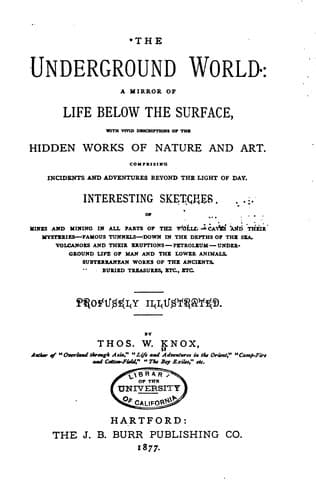
The Underground World: A mirror of life below the surfaceKnox, Thomas Wallace
History
The Underground World: A mirror of life below the surface
Knox, Thomas Wallace
Caves; Mines and mineral resources; Social history -- 19th century; Tunnels
masterly ornamental objects of massive gold in the form of crosses;
also a large golden vase weighing one and seven-eighths kilogrammes:
it has two handles, a large foot, and ornamented with three upper and
two lower parallel lines, between which is a row of fourteen stars;
further, a large golden vase with one handle, and an ornamentation
representing seven beautiful flowers; another golden vase with two
handles; further, a splendid little golden _œhœ_, or wine can, with
an ornamentation of spiral lines. Further, six golden drinking cups,
one of which is a drinking cup with two handles, on each of which is
a pigeon, each of the two handles being joined to the foot by two
separate golden blades. This goblet reminds us of Nestor’s goblet,
which was also ornamented with pigeons (see ‘Iliad,’ XI, 632, 635).
One of the other goblets is ornamented with parallel flutings. There
were further found two small golden vessels; also, eight silver
vases, three of which are admirably conserved; one of the other has
its bottom and the mouth of bronze; below its bottom were found one
hundred of the aforesaid golden buttons. I further found, in this
tomb, thirteen large bronze vessels. This kind of vessel was in high
esteem in the heroic age, and we see them continually mentioned by
Homer as prizes in the games. I suppose that to each hero were given
in the grave the goblets and other objects which were dear to him in
his lifetime, having been won by him in the games, or having been
given to him by his host as a pledge of hospitality and friendship.
There was also found a large quantity of small perforated amber balls
of necklaces, and a bronze or copper fork with three teeth, which
had probably served on the funeral pyres. There were further found
thirty-five arrow heads of obsidian. Nothing could give a better idea
of the great antiquity of these tombs than these stone arrow-heads,
for the ‘Iliad’ seems to know only arrow-heads of bronze (_e.g._,
‘Iliad,’ XIII, 650 and 662). Probably there had also been deposited
bows and quivers in the tomb, but they would have been of wood, and
would have rotted away. To my greatest regret, among thousands of gold
ornaments, there is not even a single sign resembling writing, and it
therefore appears certain that the sepulchres belong to an epoch which
preceded the introduction of the Phœnician alphabet. Had the latter
been known, the Mycenæan goldsmiths, whose continual efforts appear
to have been directed to the invention of a new ornamentation, would
have been very ambitious to show the novelty of the alphabet. A second
proof of the immense antiquity of these tombs, is the entire absence
of any vestige of either iron or glass, or of any pottery made on the
potter’s wheel. But the hand-made pottery had reached a high degree of
perfection, such as has never been attained here in later times by the
pottery made on the wheel.”
Public-domain text, read in full here on John Shaqi.
Reviews
Reviews
No reviews yet
Be the first to share your thoughts on this work.
Elsewhere in the archive
Join the Discussion
Join the discussion
Sign in to leave a comment or review.
Sign InorCreate an account