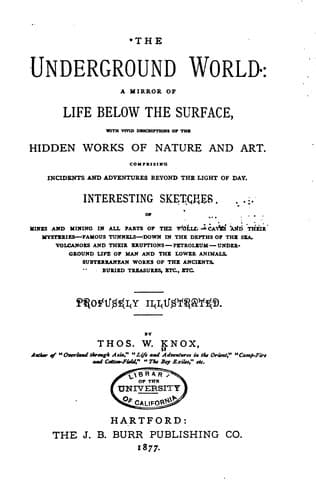
The Underground World: A mirror of life below the surfaceKnox, Thomas Wallace
History
The Underground World: A mirror of life below the surface
Knox, Thomas Wallace
Caves; Mines and mineral resources; Social history -- 19th century; Tunnels
It is but proper that we should allude here to the fact that Mrs.
Schliemann is most ably and energetically assisting her husband in the
discovery of the treasures of the ancients.
[Sidenote: THE SECOND TREASURY.]
The dome of the Second Treasury was broken in, a long time ago, and
therefore it is better known to antiquarians; but Mrs. Schliemann
has now thoroughly excavated, and explored the whole building. While
her husband was excavating within the walls of the Acropolis, she
undertook the excavation of this relic of the past, and the approach
to it, which was formerly completely concealed, is now laid bare. Its
position is close to the Gate of Lions, and it is found to differ only
in slight details from the other one, known as the Treasury of Athens.
The lintel over the doorway is the largest stone in the building. It
is twenty feet long, seven feet wide, and eighteen inches deep, and
a course of large stones of the same depth is carried all around the
walls, on the same level. The diameter of the dome is a little less
than that of the Treasury of Athens, but as there is an opening in
the top, by which the light enters, the view is not so impressive.
The inhabitants of Mycenæ did not seem to be acquainted with the
principle of the arch, as the dome is constructed with courses placed
horizontally. Dr. Schliemann, pretending that Agamemnon was buried
here, calls it the Tomb of Agamemnon; others have named it the Tomb of
Cassandra.
The Treasury of Athens shows the most perfect condition of building
of the ancients. The second, third, and fourth treasuries (there are
four in all), gradually decrease in architectural skill, and we might
almost say of the fourth, that it is nothing but an excavation made
in the soil, speedily covered with rough stones. It is covered in such
a way that a person entering it has to creep on all fours.
For what purpose these buildings were created, remains a mystery. In
the Homeric age, tombs are always described as “piled,” or “heaped
up;” they are always mounds, and the fact of the earth covering these
so-called “treasuries,” is a strong evidence of their sepulchral
character; but the magnificently built accessories would lead to the
conclusion that it belongs to a period posterior to the Iliad and the
Odyssey.
[Sidenote: HECTOR’S TOMB.]
Hector’s tomb is described as the “hollow grave.” This was the
primitive cell, which became developed into an unarched dome. Of this,
many examples are found in the tumuli near Kertch, some of them of a
very large size, and, though different in construction, they afford a
good illustrative parallel. In the structures just described, we find
a developed architecture which seems to have been rich with metallic
decoration. Here all resemblance to the simple cell of the hollow
grave has been lost, and now the foot or two feet of earth, heaped
on the top, is nearly all that is left to remind us of the original
mound, from which this style of tomb had its origin.
XV.
Public-domain text, read in full here on John Shaqi.
Reviews
Reviews
No reviews yet
Be the first to share your thoughts on this work.
Elsewhere in the archive
Join the Discussion
Join the discussion
Sign in to leave a comment or review.
Sign InorCreate an account