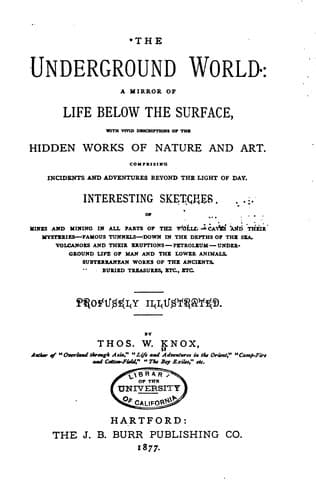
The Underground World: A mirror of life below the surfaceKnox, Thomas Wallace
History
The Underground World: A mirror of life below the surface
Knox, Thomas Wallace
Caves; Mines and mineral resources; Social history -- 19th century; Tunnels
It is known that the archæological society of Athens, under whose
direction Dr. Schliemann is now excavating at Mycenæ, and from whom he
has met with no little opposition, besides the difficulties arising
from the nature of the ground, which would seem, to a less resolute
spirit, almost insurmountable, have of late made some valuable
discoveries at Athens. They have cleared away the debris on the south
side of the Acropolis, and have discovered the temple of Æsculapius,
where they have found many bas-reliefs representing the goddess of
health, and two very beautiful marble heads, nearly perfect; also,
some inscriptions of great historical value. They have also found a
Byzantine cave under the rock. This circumstance reminds me of some
exquisite specimens of sculpture seen by me, while in Athens, in my
visit to the Acropolis. From these we return to the recent excavations
at Olympia. These are carried on by a commission from the German and
Greek governments. The latest discoveries announced are those made
on the site of the celebrated temple of Jupiter, consisting, among
others, of a Doric capital, with its abacus in excellent preservation,
considered as belonging to one of the columns supporting the eastern
pediment of the temple, fragments of bronze, and terra-cotta objects,
also, of the marble tiles described by Pausanias as composing the
roof; and a magnificent torso, supposed to be the statue of Jupiter,
one of the group of figures adorning the pediment of the temple. On
the last day of the year, however, a telegram was received by the
king from Dr. Demetriades, announcing a discovery which has filled
Athens with joy. The statue of Niké (Victory), one of the group in
the pediment, has been found imbedded in the soft, alluvial soil, in
an almost perfect condition—as if it had only yesterday been taken
down from its lofty pedestal. It is said to be a figure of unmatched
beauty and grandeur, and what gives it a higher value is that the name
of Praxitiles himself is engraved on it. Thus much is as yet known,
but details are eagerly waited. Archæological discovery is eagerly
pursued in every part of the land, of which it may be said that not
a spadeful can be turned, without revealing some new treasure of its
most glorious epoch.
The objects found by Dr. Schliemann have been forwarded to England,
and placed in charge of the National Bank. They have been placed under
the care of that institution for safety, and will remain there in the
strong room, until a suitable museum can be provided, when they will
all be labeled, and will be exposed, in proper cases, for the public
to see them.
It is a fact not generally known, that Dr. Schliemann is not assisted
by any fellow-enthusiast in the cause of archæology, nor is he in the
employ of any society. He defrays the expenses all himself, and we may
be assured that they are very heavy.
Public-domain text, read in full here on John Shaqi.
Reviews
Reviews
No reviews yet
Be the first to share your thoughts on this work.
Elsewhere in the archive
Join the Discussion
Join the discussion
Sign in to leave a comment or review.
Sign InorCreate an account