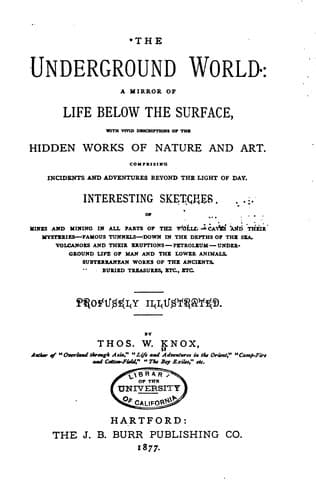
The Underground World: A mirror of life below the surfaceKnox, Thomas Wallace
History
The Underground World: A mirror of life below the surface
Knox, Thomas Wallace
Caves; Mines and mineral resources; Social history -- 19th century; Tunnels
It is a ring rising seven or eight feet above the sea level, enclosing
a lagoon, and presenting the characteristics just described. The
lagoon inside is but a few fathoms deep; but on the outside of the
island, the water is fifteen thousand feet deep. Here, then, we
evidently have a tower-like structure reaching up from the bottom of
the sea, and having a depression in its summit. Some of these lower
islands are fifty miles across, but most of them are not so large. In
some the ring is broken at several points, and these are designated by
the Malay word _atoll_.
The island of Tahiti, the principal one of the Society Islands is a
good example of the second class or higher islands. It rises seven
thousand to eight thousand feet above the level of the sea, has no
lagoon in its center, but a crater, and the water around it is very
deep. It may, in fact, be considered as a mountain rising to a height
of some eighteen thousand feet from the bottom of the sea. Outside of
it is a double girdle of low islands, one near, which Darwin calls a
fringing reef, and one further out, to which he gives the name of a
barrier reef.
On examining these reefs, and the lower islands, their structure
will be found made up entirely of animal remains, generation after
generation having left their homes, consisting of limestone, to
accumulate there. On the top, we find these animals living and
growing, in all colors, shapes, and sizes. The highest islands, on
the contrary, except those near the continent, like Borneo, Sumatra,
etc., are entirely volcanic, and do not contain sandstone, granite, or
gneiss, like the mountains of the continent.
The limestone of the lower islands is not due to sedimental deposits
from the ocean, but is the work of the coral animal, the great
architect of the sea.
[Sidenote: WHAT THE CORAL IS.]
The great savant, Prof. Agassiz, describes them as follows:
“These animals are but a sac, like the finger of a glove, only more
leathery. Around the mouth is a series of tentacles, formed by a
prolongation of the skin. They are all skin, in fact, and have no
special organs, yet they digest food with tremendous rapidity,
absorbing it directly. It makes no difference if you turn them inside
out; they will digest just as well as before. You cannot kill them by
dividing them; for they live all over, like a plant. For this reason
they have been called zoöphytes.[1] If you cut one into eight parts,
each part will live and set up in business for itself. Like all other
animals, however, they grow out of eggs. The eggs are formed within
the skin, which is double, and divided into cells by partitions or
septa. When mature, they detach themselves, move about in the water
until they find a favorable place, and then establish a new colony.
They do not contribute to the growth of their parent colony, which is
effected in another way.
Public-domain text, read in full here on John Shaqi.
Reviews
Reviews
No reviews yet
Be the first to share your thoughts on this work.
Elsewhere in the archive
Join the Discussion
Join the discussion
Sign in to leave a comment or review.
Sign InorCreate an account